DTG Printing with No Minimum
DTG (direct to garment) printing works like an inkjet printer for clothing: water-based ink is sprayed straight onto the fabric, so a full-color photo needs no more setup than a one-color logo. There is no minimum order, which makes it the right choice for samples, short runs, personalized pieces and detailed art. It prints best on 100% cotton.
- Quote response24 hours
- MinimumNo minimum
- ProductionSouthern California
- Ships toUS and worldwide
DTG Printing, done right.
DTG removes the setup that makes small orders expensive. There are no screens to burn and no colors to separate, so a single shirt, twelve shirts in mixed sizes or a design with hundreds of colors all start the same way: a file goes to the printer and the printer lays the image down. That is why DTG has no minimum, and why it is the method of choice for samples, pre-orders, one-off gifts and art that would need too many screens to print any other way.
It is not the answer to everything. DTG ink goes down thinner than screen printing ink, so prints on dark garments are a little less punchy than plastisol, and the cost per shirt changes far less with quantity. It is also tied to cotton: high polyester content and some dyed fabrics give muted or unstable results. The sections below explain where DTG wins, where it does not, and how to set up artwork so it prints the way it looks on screen.
From file to finished.
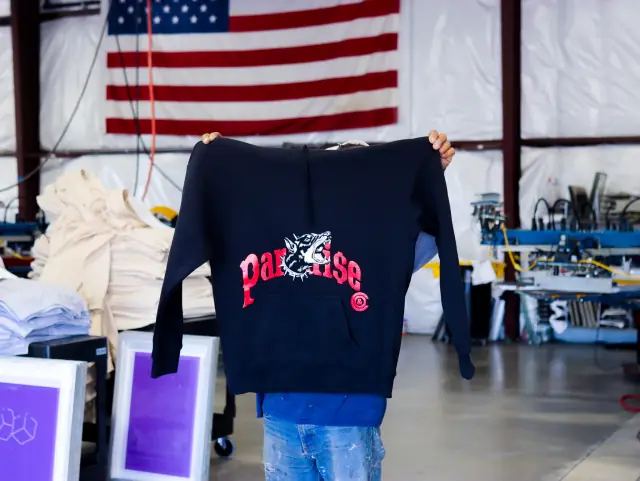
A DTG printer is a garment-sized inkjet. The shirt is loaded onto a platen, and print heads pass over it laying down CMYK water-based pigment ink, much like a desktop printer on paper. Because the image is built from tiny droplets rather than separate screens, gradients, photos and fine detail print with no extra setup, and each shirt in an order can carry a different design.
Dark garments need pretreatment first. A liquid is sprayed onto the print area and heat-pressed dry; it gives the white ink something to grip so it sits on top of the fibers instead of soaking in. The printer then lays down a white base and prints the colors over it. Pretreatment can leave a faint visible patch on some colors and heathers that normally fades with washing. Light garments often need little or no pretreatment and no white ink.
After printing, the ink is cured with a heat press or a conveyor dryer so the pigment bonds to the fabric. Proper curing is what lets a DTG print hold up in the wash, and it is checked on the first pieces before the rest of the order runs. A print that skips or rushes this step can look perfect on day one and fade fast.
DTG inks are made to bond with cotton. On 100% cotton the color is brightest and the print lasts longest; on cotton-rich blends the result is still good but a little softer in tone. Tri-blends print with a faded, vintage look, and garments with high polyester content are a poor match, because the ink does not grip polyester as well and the garment dye can bleed into the white layer.
When to choose it, and when not to.
- You need a few pieces, a sample or a single shirt, since DTG has no minimum order.
- The artwork is a photograph, painting or design with gradients and many colors.
- Every piece in the order is different, such as names, dates or individual designs.
- You want to test a design on real shirts before committing to a screen printed run.
- You are filling pre-orders or small restocks in mixed sizes and colors.
- The garment is 100% cotton and you want a soft print with no heavy ink layer on a light color.
- You are ordering a large run of one design, where screen printing costs less per shirt once the setup is spread out.
- You need an exact Pantone match on a brand color; spot-color screen printing mixes the ink to the reference.
- The garment is mostly polyester, like performance wear, where DTG ink grips poorly and all-over print sublimation is made for the fabric.
- You want the boldest possible color on black shirts that will take heavy wear, where plastisol screen printing is brighter and tougher.
- The logo is going on a hat, beanie or jacket, where embroidery is the better finish.
What we can do
No minimum order
Order a single piece or a full run. With no screens or separations to set up, small quantities and mixed sizes start the same way as large ones, which makes DTG the natural fit for samples and short runs.
Full-color photo printing
CMYK ink builds gradients, photos and detailed illustration from fine droplets, so the number of colors in a design adds no setup and does not need to be reduced to save screens.
Light garments
On white and light colors the inks print straight into the fabric, usually with little or no white ink, for a soft, breathable print that feels close to the shirt itself.
Dark garments
Black and dark shirts are pretreated, then printed with a white base under the color. The print feels slightly heavier than on a light shirt and the colors are a touch less saturated than plastisol, but the detail stays sharp.
Personalized and variable designs
Because each print is just a file, names, numbers, dates or a different design on every shirt can run in the same order without any extra setup between pieces.
What to send
- 01
Transparent PNG at 300 dpi
Send a PNG with a transparent background, built at 300 dpi at the size it will print. A 12 inch wide print needs a file about 3,600 pixels wide.
- 02
Avoid soft, semi-transparent edges
Drop shadows, glows and partly transparent pixels can print as a faint haze or a pale fringe on dark shirts. Make edges solid or knock them out cleanly.
- 03
Remove background boxes
A white or colored rectangle behind the design prints as a block. Delete any background that should let the shirt color show through, unless the box is part of the design.
- 04
Expect some color shift
Screens glow and fabric does not, so bright on-screen colors print a little duller, especially on darks. Neon shades and exact Pantone matches sit outside what CMYK ink can reach.
What it suits best
- 01
100% cotton tees
Ring-spun, combed cotton gives the brightest color and sharpest detail, because its smooth surface holds each droplet where it lands.
- 02
Cotton-rich blends
Blends like 60% cotton, 40% polyester print well with slightly softer color. Ask for a sample first if brand color accuracy matters.
- 03
Cotton hoodies and crewnecks
Fleece with a cotton face prints well, though the kangaroo pocket and the seams set the limits on how large a front print can go.
- 04
Tri-blends
The cotton and rayon take the ink and the polyester largely does not, which gives a soft, faded, vintage look. Good for that style, wrong for bold color.
- Wash DTG prints inside out in cold water on a gentle cycle.
- Hang dry or tumble dry on low heat to keep the colors bright longer.
- Skip bleach and harsh stain removers, which fade water-based pigment inks.
- Do not iron over the print; iron the garment inside out if it needs it.
One shop, start to finish.
- Print full-color DTG on light and dark garments with no minimum order.
- Check your file and send a digital mockup for approval before anything prints.
- Help you pick a cotton blank for DTG from the makers we source, among them AS Colour, Los Angeles Apparel, Made Blanks and Blanks by Thirteen, then check it on arrival.
- Print and check the first pieces before the rest, with fast turnaround on small runs.
- Fold, bag and label finished pieces, then ship them to you or pick, pack and ship orders to your customers.
Six steps, nothing skipped.
Minimums and turnaround depend on the method, the garment and the run. The quote spells out both within 24 hours. DTG printing has no minimum, so a run of a few pieces is welcome.
- 01
Quote & discovery
Send the details and artwork. Within 24 hours you get line-item pricing for garments, decoration, finishing and quantities, with a committed timeline.
- 02
Specs & approval
Artwork is reviewed, a spec sheet is issued and a digital mockup is approved before anything runs. Sizes and colorways are confirmed here.
- 03
Sourcing & setup
Blanks are sourced and checked on arrival. Screens are burned or embroidery digitized, files are prepped and a strike-off is run.
- 04
Production
The first pieces are checked and signed off before the full run, with color and registration checks along the way.
- 05
Finishing & packaging
Labels applied, folded, bagged, tagged and packed to spec, then a final QC pass.
- 06
Delivery & fulfillment
Bulk shipped to you, your warehouse or a retailer, or picked, packed and shipped order by order to your customers.
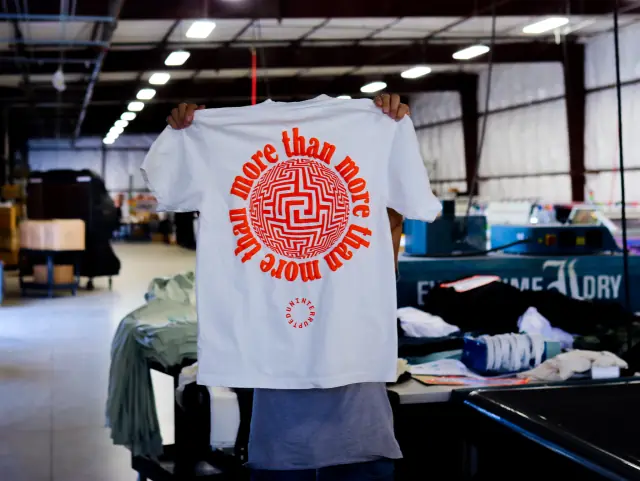
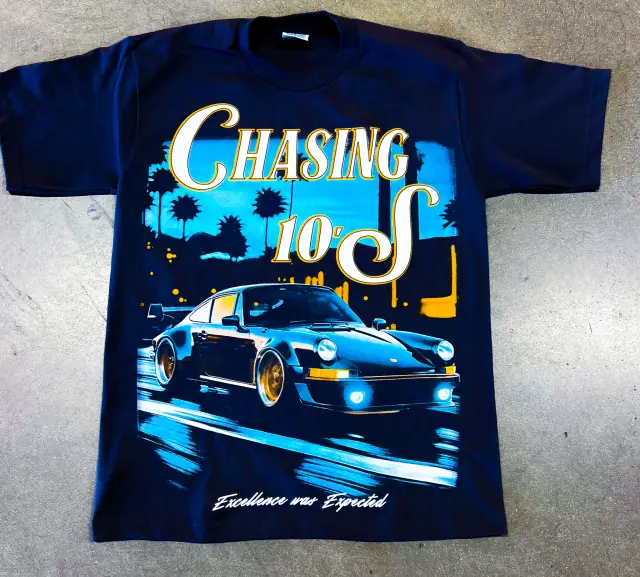
From the production floor
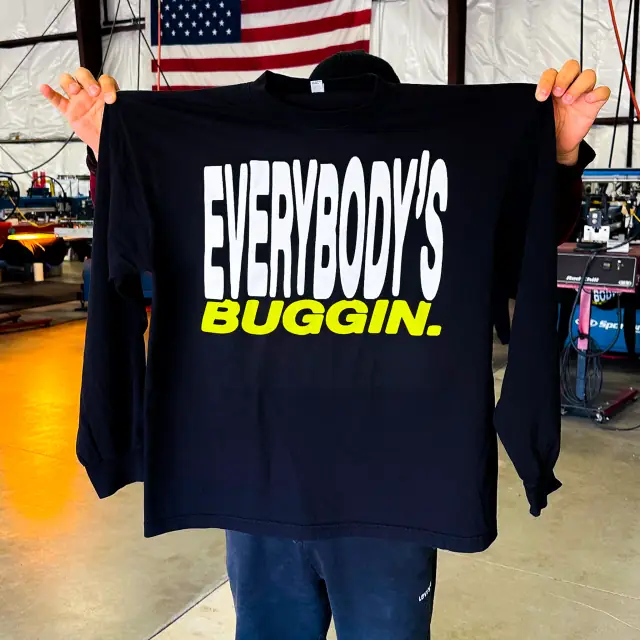
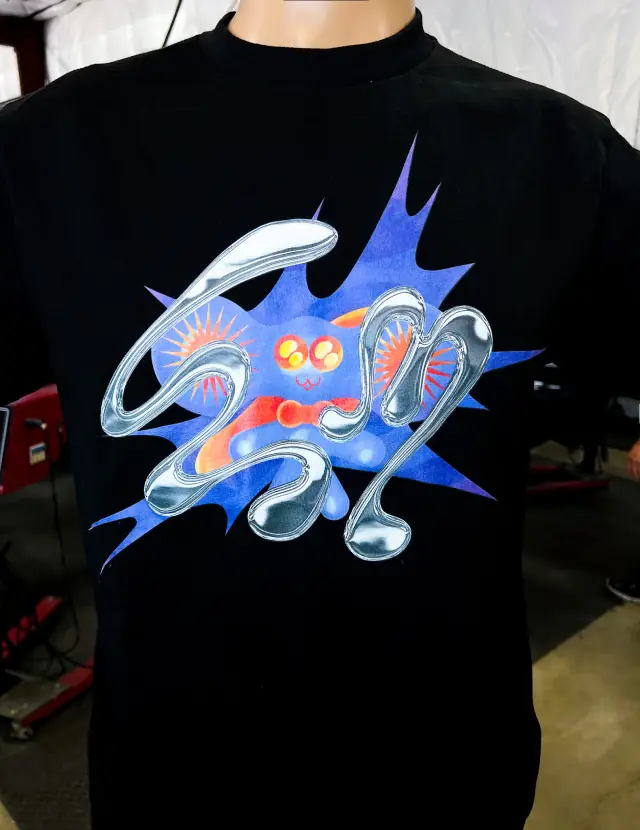
Recent Merch Mob production.
DTG Printing questions
Is there a minimum order for DTG printing?
No. DTG has no minimum order, so you can print a single shirt or a short run. There is no screen setup to spread across the order, which is what makes small quantities practical. The per-shirt price still depends on the garment, the print size and whether it is a dark shirt that needs pretreatment and white ink.
Is DTG or screen printing better?
Neither wins outright. DTG is better for small runs, photo art and many-color designs, and it has no minimum. Screen printing is better for larger runs of one design, exact Pantone colors and the boldest prints on dark garments, and it costs less per shirt as quantity rises. A common path is to test a design with DTG and move it to screen printing once it sells.
Does DTG work on black shirts?
Yes. Dark shirts are pretreated, then printed with a white ink base under the full-color image. The result is sharp and detailed, though colors are slightly less vivid than a plastisol print and the print area feels a little firmer than it would on a white shirt.
How long do DTG prints last?
A properly pretreated and cured DTG print on cotton holds up to regular washing, but it will usually soften and fade sooner than a well-cured plastisol print. Washing inside out in cold water and avoiding high dryer heat make the biggest difference. For uniforms or workwear washed hot and often, screen printing or embroidery is the safer choice.
Can you print on polyester with DTG?
DTG ink is designed for cotton, so the best results come from 100% cotton and cotton-rich blends. Garments with a lot of polyester tend to print duller and can let the fabric dye bleed into the white base. For polyester performance wear, sublimation through all-over print, or screen printing with a low-bleed ink, is usually the better route.
How much does DTG printing cost?
Price depends on the blank, the print size, the number of print locations and whether the shirt is dark, since dark garments need pretreatment and white ink. Quantity matters less than with screen printing because there is no setup to spread out. Send the design and garment, and the quote comes back within 24 hours with line-item pricing.
How fast can you turn a DTG order?
Small DTG runs are quick to set up because there are no screens to make. Actual timing depends on blank stock, quantity, mockup approval and how the order ships, so the quote gives you a committed timeline. If you have a hard date, put it in the request.
What file should I send for DTG?
A PNG with a transparent background at 300 dpi at print size is ideal. PSD, PDF, AI, EPS, SVG and high-resolution JPG files also work. For dark shirts, avoid soft shadows and semi-transparent edges, and remove any background box that is not part of the art.
Read before you order
Screen Printing vs DTG: Which Is Right for Your Order?
Screen printing pushes ink through a stencil, one screen per color, so it carries setup work but gets cheaper per shirt as quantity grows and gives the brightest,…
Merch LibraryDTF vs DTG: Differences, Feel and When to Use Each
DTG prints ink straight into the garment with an inkjet, giving a soft print that works best on cotton. DTF prints the design onto film, adds an adhesive powder and…
Merch LibraryTypes of Shirt Printing Compared: Screen Print, DTG, DTF and More
The main ways to decorate a shirt are screen printing, DTG (direct to garment), DTF (direct to film), sublimation, heat transfer vinyl and embroidery. Screen…
Merch LibraryHow to Choose a Blank T-Shirt for Your Merch
Pick the blank that suits the wearer, the decoration method and the budget at the same time. Decide who wears it and how often, match the fabric to the print method…
Merch LibraryRing-Spun vs Open-End vs Combed Cotton Yarn
Ring-spun yarn is twisted from a thin, drafted strand of fibers on a spinning ring, which makes it strong, soft and smooth. Open-end yarn is formed in a fast rotor…
Merch LibraryPrint-on-Demand vs Bulk Production: When Each Makes Sense
Print-on-demand makes each item only after a customer orders it, usually by DTG or DTF printing, so you hold no stock and risk no cash, but pay more per unit and…
Merch LibraryPre-Orders vs In-Stock Drops: Cash, Risk and Wait Times
A pre-order sells the item first and produces it after the window closes, so customer payments fund production and real orders set the size run, but buyers wait. An…
- Montclair
- Pomona
- Chino
- Diamond Bar
- Fontana
- Corona
- Anaheim
- Riverside
- El Monte
- Colton
- Santa Ana
- San Bernardino
- Garden Grove
- Norwalk
- Pasadena
- Irvine
- Moreno Valley
- Huntington Beach
- Los Angeles
- Mission Viejo
- Long Beach
- Glendale
- Inglewood
- Laguna Niguel
- Victorville
- Yucaipa
- West Hollywood
- Menifee
- Torrance
- Manhattan Beach
- Beaumont
- Palmdale
- Murrieta
- Santa Monica
Let’s build
your next drop.
Tell us what you are making. You get a line-item quote, an honest timeline and production advice within 24 hours.