Custom Screen Printing
Screen printing pushes ink through a fine mesh stencil, one screen per color, onto the garment. It gives the most durable, vibrant print for a run of the same design, and the price per piece drops as quantity rises. Merch Mob screen prints plastisol, water-based and discharge inks on light and dark garments, from one-color logos to jumbo prints and designs of six or more colors.
- Quote response24 hours
- MinimumSet in your quote
- ProductionSouthern California
- Ships toUS and worldwide
Screen Printing, done right.
Screen printing is still the method most merch is judged by. The ink goes down as a solid layer of color, so a properly cured print often outlasts the shirt it sits on, and spot colors are mixed to a Pantone reference instead of approximated by a printer's color profile. Once the screens are burned, each extra shirt costs little more than the blank and the ink, which is why tour runs, brand drops and staff orders of one design almost always end up on a press.
The trade-off is setup. Each color in the design needs its own screen, and each print location needs its own set, so a short run of a busy design carries a lot of setup per shirt. The decisions that matter most happen before anything prints: which ink suits the garment and the look you want, how many colors the art really needs, and how big the print should be across the size run. This page covers those choices and what we need from you to quote.
From file to finished.
Every job starts with separations: the artwork is split into one layer per ink color, and each layer is output as a film positive. A screen, which is a frame stretched with polyester mesh, is coated with light-sensitive emulsion, the film is laid on it and the screen is exposed. Where the art blocked the light, the emulsion washes out and leaves open mesh in the shape of that color. Coarse mesh passes the heavy deposit a white underbase needs, while fine mesh holds halftone dots and thin lines.
On press, the screens are locked into registration so each color lands exactly where it should relative to the others. The printer floods ink across the screen, then pulls a squeegee to force it through the open mesh onto the garment, which sits on a flat board called a platen. On a dark shirt, a white underbase is usually printed first and flash-cured so the colors on top stay bright instead of sinking into the fabric.
Ink choice sets the look and the feel. Plastisol is the opaque, vivid standard: it sits on top of the fabric and prints cleanly on light and dark garments. Water-based ink soaks into the fibers for a soft hand you barely notice. Discharge ink removes the garment's dye and deposits color in its place, so a print on a black tee can feel like part of the fabric, but it only works on cotton dyed with reactive dyes, and the result shifts from one dye lot to the next.
After the last color, the garment rides a conveyor dryer until the ink reaches its cure temperature. Most standard plastisols cure at around 320°F (160°C), while water-based and discharge inks also need their water driven off, so they need more time in the heat. Undercured ink looks fine coming off the press, then cracks or washes out, which is why test prints get stretched and checked and the first pieces of a run are signed off before the rest are printed.
When to choose it, and when not to.
- You are ordering a run of one design across a size range and want the price per piece to fall as quantity rises.
- The design is built from a limited set of solid colors, such as a logo, lettering or illustrated art.
- You need brand colors matched to a Pantone reference rather than the nearest color a digital printer can reach.
- You want a soft, worn-in print on cotton using water-based or discharge ink.
- The order calls for a bright, opaque print on black or dark garments that will see hard wear.
- You want a jumbo or oversized print that fills most of the shirt front or back.
- You plan to reorder the same design, because an approved spec sheet makes a repeat run match the first one.
- You need a handful of shirts, a sample or one-off personalized pieces: DTG has no minimum and no screens to set up.
- The art is a photograph or soft gradient with dozens of tones, which DTG reproduces without paying for extra screens.
- You want a raised, stitched logo on caps, beanies, polos or jackets, where embroidery looks and wears better.
- The design has to run edge to edge across the seams of a polyester garment, which is a job for all-over print.
What we can do
Plastisol ink
The opaque, durable workhorse. Plastisol sits on top of the fabric, prints bright on lights and darks, gives the crispest edges, and handles polyester blends when a low-bleed ink is used to block dye migration. It has more hand than water-based ink, especially over an underbase.
Water-based ink
Ink that soaks into the fibers instead of sitting on them, for a soft print that gets softer after the first wash. It looks best on light and mid-tone cotton and suits vintage, lived-in designs. On dark garments it usually needs a discharge additive or a base layer.
Discharge ink
Discharge strips the reactive dye out of cotton and leaves pigment in its place, giving an almost weightless print on dark shirts. Colors can land slightly differently from the screen proof, so a strike-off on the actual blank matters. Polyester, many blends and some dyes will not discharge.
Spot color
Each color prints as a solid ink mixed to your reference, usually a Pantone number. It is the cleanest, most consistent way to print logos and graphic art, and every color you cut from the design is one less screen to set up.
Jumbo and oversized prints
Prints that run well past a standard full front, such as a 14 by 18 inch print across the back. They take larger screens and a heavier ink deposit, and the art often needs a reduced version for the smallest sizes in the run.
Six-plus color designs
Multi-color builds of six or more colors for detailed illustration and art with many tones. More colors mean more screens and more press time, so the file review is the moment to ask whether halftones could hold the look with fewer screens.
What to send
- 01
Vector, or 300 dpi at print size
Send AI, EPS, PDF or SVG vector files where you have them. Raster art (PNG, PSD or JPG) should be 300 dpi at the size it will print, not at screen size.
- 02
Outline fonts and flatten effects
Convert type to outlines so a missing font cannot change the layout, and flatten drop shadows, glows and textures, or note that they are meant to print as halftones.
- 03
Name your colors
List the Pantone references you want matched and the garment color for each version of the design. The same ink reads differently on a black shirt than on a white one, so state both.
- 04
Give size and placement
State the print width in inches for each location, such as a 3.5 inch left chest or a 12 inch full front, and how far below the collar it should sit.
- 05
Approve the mockup
We send back a digital mockup and spec sheet showing ink colors, sizes and placements. Nothing goes to press until you approve it.
What it suits best
- 01
Heavyweight cotton tees
A tight-knit cotton tee of 6 to 7 oz/yd² (about 200–240 GSM) gives ink a smooth, stable surface and carries jumbo prints without puckering or the fabric showing through.
- 02
Ring-spun midweight tees
Combed, ring-spun jersey has fewer loose fibers on the surface, so fine lines and halftones print crisply. It is also a good base for soft-hand water-based prints.
- 03
Fleece hoodies and crewnecks
Cotton-rich fleece takes plastisol and water-based ink well. Plan the placement around the kangaroo pocket and seams, and expect a slightly softer edge on the fluffier surface.
- 04
Garment-dyed tees
Pre-washed, garment-dyed blanks give a broken-in look, but the base color varies from lot to lot. Test discharge on them first, since results vary with the dye.
- 05
Cotton/poly blends and tri-blends
Blends print well with plastisol and give a softer, heathered look, but they only partly discharge, and polyester dye can bleed into light inks unless a low-bleed base is used.
- Turn the garment inside out and wash it in cold water with similar colors.
- Tumble dry low or hang to dry so the shirt does not shrink around the print.
- Never iron directly on the print, and skip dry cleaning, which can soften plastisol.
- Keep bleach away from the garment; it attacks both the ink and the dye around a discharge print.
One shop, start to finish.
- Review your artwork, prep the files and send a spec sheet with a digital mockup for your approval before anything runs.
- Source blanks from makers including Los Angeles Apparel, AS Colour, Shaka Wear, Cotton Heritage and Made Blanks, and through the distributors S&S Activewear and alphabroder.
- Check every blank on arrival, then burn the screens and pull a strike-off on the actual garment.
- Print spot color, plastisol, water-based and discharge on light and dark garments, including jumbo prints and designs of six or more colors.
- Sign off the first pieces before the full run, check color and registration on press, and pull QC samples as the run goes.
- Label, fold, bag and pack the finished run to your spec, then ship it in bulk or fulfill it order by order from So Cal.
Six steps, nothing skipped.
Minimums and turnaround depend on the method, the garment and the run. The quote spells out both within 24 hours. DTG printing has no minimum, so a run of a few pieces is welcome.
- 01
Quote & discovery
Send the details and artwork. Within 24 hours you get line-item pricing for garments, decoration, finishing and quantities, with a committed timeline.
- 02
Specs & approval
Artwork is reviewed, a spec sheet is issued and a digital mockup is approved before anything runs. Sizes and colorways are confirmed here.
- 03
Sourcing & setup
Blanks are sourced and checked on arrival. Screens are burned or embroidery digitized, files are prepped and a strike-off is run.
- 04
Production
The first pieces are checked and signed off before the full run, with color and registration checks along the way.
- 05
Finishing & packaging
Labels applied, folded, bagged, tagged and packed to spec, then a final QC pass.
- 06
Delivery & fulfillment
Bulk shipped to you, your warehouse or a retailer, or picked, packed and shipped order by order to your customers.
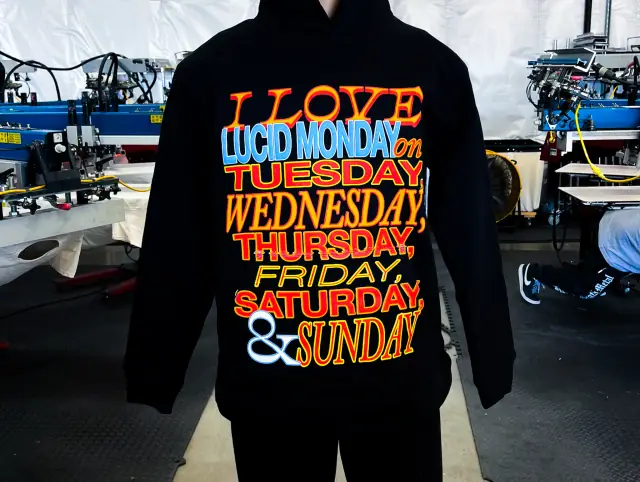
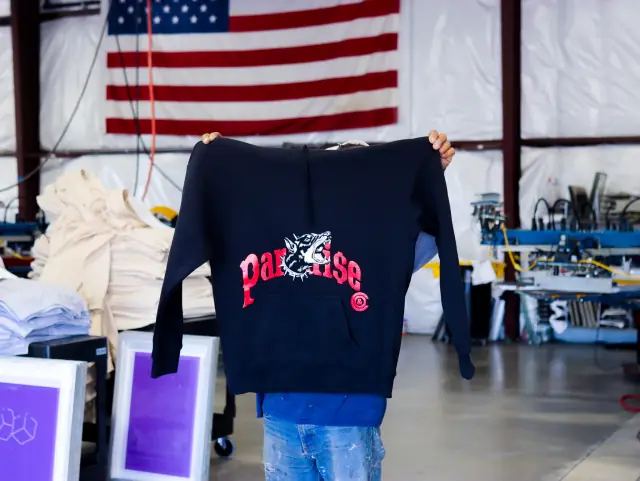
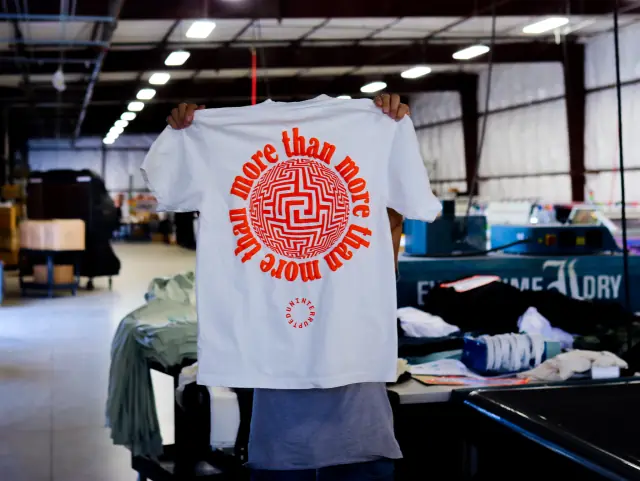
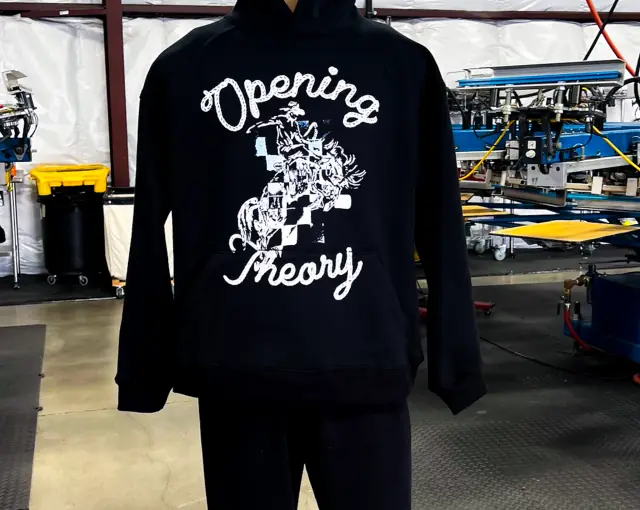
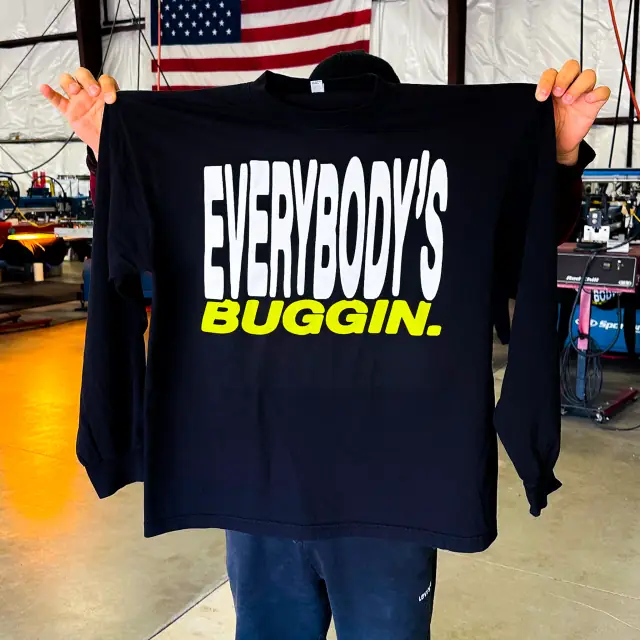
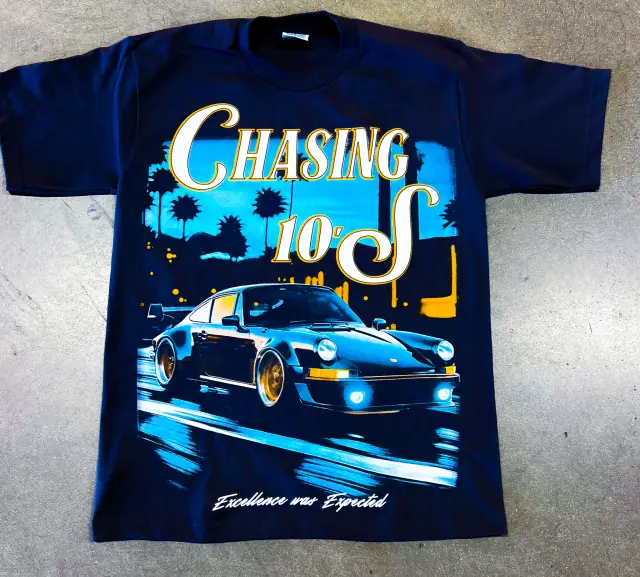
From the production floor
Recent Merch Mob production.
Screen Printing questions
What is the minimum order for custom screen printing?
Minimums depend on the design and the run. Every ink color needs its own screen and every location its own set, so a one-color logo starts to make sense at a different quantity than a six-color back print. Send the art and a rough count and the quote states the minimum and the per-piece price within 24 hours. For a handful of shirts, DTG has no minimum.
How much does screen printing cost?
The price per piece comes from the blank, the number of ink colors, the number of print locations, the quantity, choices like discharge or oversized screens, and finishing such as neck labels or bagging. Quantity has the biggest effect, because setup is spread over every shirt. Our quotes break these out line by line, so you can see what changes if you drop a color or add a sleeve print.
How long does a screen printing order take?
Timing depends on blank stock, how quickly the mockup is approved, the number of screens, any finishing and how the order ships. The quote comes with a committed timeline, so tell us your in-hands date up front. When a date is tight, fast mockup approval and an in-stock blank are the two things that help most.
Plastisol, water-based or discharge: which ink should I choose?
Pick plastisol for bright, opaque color on any shirt color and the widest range of fabrics. Pick water-based for a soft hand on light or mid-tone cotton. Pick discharge when you want a soft print on a dark, 100% cotton shirt and can accept slight color variation. If you are unsure, describe the look you want and the blank, and the spec review is where the ink gets settled.
Can you screen print on black and dark shirts?
Yes. Plastisol prints on darks over a white underbase that is flash-cured before the top colors go down, which keeps them bright. Discharge is the soft-hand option on dark cotton. Water-based ink on its own tends to look muted on dark fabric, so it is usually mixed with a discharge agent or printed over a base.
How big can a screen print be?
Oversized work is part of what we do, including prints around 14 by 18 inches. The practical size depends on the garment and the smallest size in the run, because a print that fills an XL can wrap into the side seams on a small. Tell us the sizes you are ordering and the quote and mockup will confirm the print size.
What files do you need for screen printing?
Vector files (AI, EPS, PDF or SVG) are best. A PNG, PSD or JPG works if it is 300 dpi at the printed size. Include Pantone references for brand colors and the garment colors you want. You can attach files to the quote form or email them to merchmobmfg@gmail.com.
Do you handle labels, bagging and shipping too?
Yes. After printing we can apply neck labels, fold, bag and tag, and pack to your spec. The finished run can then ship in bulk to a warehouse or retailer, or we can pick, pack and ship orders to your customers from Southern California.
Read before you order
What Is Screen Printing? How It Works, Step by Step
Screen printing pushes ink through a fine mesh screen onto a garment, using a light-hardened stencil that blocks the mesh everywhere except the design. Each color…
Merch LibraryScreen Printing Inks: Plastisol, Water-Based and Discharge
Most garment screen printing uses one of three ink families. Plastisol is a PVC-based ink that sits on top of the fabric and only cures with heat; it is opaque,…
Merch LibrarySpot Color vs Simulated Process vs CMYK Screen Printing
Spot color prints each color as its own solid ink, which suits logos and flat graphics. Four-color process (CMYK) builds full color from tiny cyan, magenta, yellow…
Merch LibraryWhat Drives Screen Printing Cost (and How Many Colors to Use)
Screen printing cost is mostly setup spread over quantity. Every color in every print location needs its own screen, and a white underbase on a dark shirt counts as…
Merch LibraryPreparing Artwork for Screen Printing: Files and Separations
Send vector art (AI, EPS, PDF or SVG) for logos and type, or a raster file at 300 dpi at the final print size for photos and painted art. Outline fonts, name the ink…
Merch LibraryT-Shirt Print Placement and Size Guide
On an adult tee, a left chest logo is typically about 3–4 inches wide, a center chest print about 8–10 inches wide, and a full front about 10–12 inches wide with its…
Merch LibraryJumbo and Oversized Screen Prints: Sizes, Platens and Limits
A standard full-front screen print is usually about 10–12 inches wide. Oversized prints run roughly 12–15 inches wide, and jumbo prints go further, often 14–16…
Merch LibraryScreen Printing vs DTG: Which Is Right for Your Order?
Screen printing pushes ink through a stencil, one screen per color, so it carries setup work but gets cheaper per shirt as quantity grows and gives the brightest,…
- Montclair
- Pomona
- Chino
- Diamond Bar
- Fontana
- Corona
- Anaheim
- Riverside
- El Monte
- Colton
- Santa Ana
- San Bernardino
- Garden Grove
- Norwalk
- Pasadena
- Irvine
- Moreno Valley
- Huntington Beach
- Los Angeles
- Mission Viejo
- Long Beach
- Glendale
- Inglewood
- Laguna Niguel
- Victorville
- Yucaipa
- West Hollywood
- Menifee
- Torrance
- Manhattan Beach
- Beaumont
- Palmdale
- Murrieta
- Santa Monica
Let’s build
your next drop.
Tell us what you are making. You get a line-item quote, an honest timeline and production advice within 24 hours.