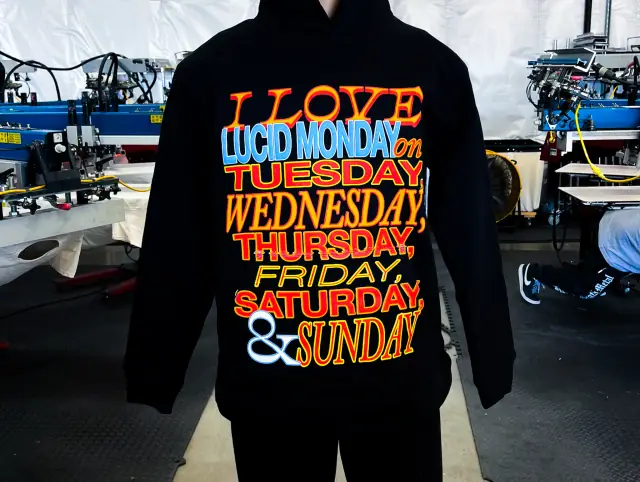
Start with the size, in inches
"Oversized" means different things to different printers, so the first step is to measure. Size the art you have in mind at the dimensions you want it printed, then compare it with the smallest garment in your run. That single comparison settles most of what follows: whether a standard press can do it, whether the print needs graded sizes, and whether it is a jumbo print at all or really an all-over job.
This section covers three families of work:
- Jumbo and oversized prints are single prints wider or taller than a standard full front, printed on a finished garment with larger screens, wider squeegees and bigger platens.
- All-over and over-the-seam prints cover the garment edge to edge, either by printing fabric panels before they are sewn or by printing across the seams of a finished piece.
- Odd-location prints go on sleeves, hoods and pockets, around zippers and inside the neck: small areas, each with its own fixture and its own limits.
How to read this section
- Start with jumbo and oversized screen prints. It sets out the chain of limits (press image area, screen frame, platen, flash and dryer, and the garment itself), explains graded print sizes across a size run, and shows where the extra cost of a big print comes from. Those ideas apply to everything else here.
- If the design has to cover the whole garment or cross seams, read all-over print vs over-the-seam printing. It compares cut-panel sublimation, which needs polyester, with the screen printing routes that keep a cotton blank, and explains the artwork templates each one needs.
- If the design adds hits away from the main body, read printing on sleeves, hoods, pockets and zippers for typical sizes, the fixtures each spot needs and the US label rules that apply to inside-neck prints.
What holds across all of it
- Every location and size group is a setup. Large screens, special pallets, graded art and extra locations each add work before the first garment is printed, which is why big and unusual prints tend to need more setup, and often higher minimums, than a one-location logo tee.
- The garment matters as much as the press. Body width, cut, seams, pockets and zippers decide what physically fits. Boxy and oversized fits give a big print room; fitted cuts take it away.
- Feel grows with area. A large plastisol print over a white underbase is heavy and warm. Water-based and discharge inks, and artwork with open space in it, keep big prints wearable; screen printing inks compares the options.
- Mockups and samples earn their keep. A print that looks right on a flat mockup can land in an armpit, a pocket seam or under a hood on the real garment, so check every size and every location before production.
For the standard placements that oversized work grows out of, start with the print placement and size guide, and for how setup and colors shape a quote, see what drives screen printing cost. The screen printing and all-over print pages describe the methods themselves.