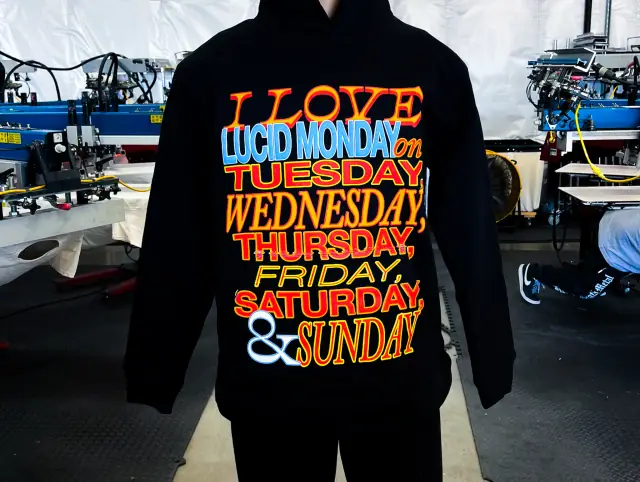
Four ways to cover more of a garment
"All-over print" gets used for several processes that look nothing alike up close. Before you compare quotes, pin down which one each printer means.
| Method | How it works | Fabric | Coverage | What to expect |
|---|---|---|---|---|
| Cut-panel sublimation | Fabric panels are printed first, then cut and sewn into the garment | Polyester or high-polyester knits with a white or light base | Edge to edge, across every seam, sleeve and hem | No ink layer to feel; bright color; a polyester hand |
| Sublimating a finished garment | A sewn polyester garment is pressed with a large transfer | Polyester, light colors only | Most of the surface | White streaks where seams and folds kept the paper off the fabric |
| All-over screen print | Very large screens print a finished garment on an oversize or all-over pallet | Anything screen printing handles, including cotton | Most of the front or back, stopping short of seams and edges | Soft or heavy feel depending on ink; a visible boundary where the print ends |
| Over-the-seam print | Ink is printed across shoulder, side or sleeve seams of a finished garment | Anything screen printing handles | A graphic that wraps over a seam | Small skips and breaks along each seam ridge |
The first and last rows are the ones people usually mean when they say "all-over" and "over-the-seam". The middle rows are the compromises in between, and knowing they exist explains why two all-over quotes can differ so much.
Cut-panel sublimation: true edge to edge
Sublimation uses dye inks printed onto transfer paper. Under heat and pressure, the dye turns to gas and bonds into polyester fibers, so the color becomes part of the yarn rather than a layer sitting on it. In cut-panel all-over print, that happens before the garment exists:
- The pattern pieces for each size (front, back, sleeves, collar or hood, pocket) are laid out as print templates.
- The artwork is placed on every piece, with bleed running past the cut line.
- The layout is printed onto transfer paper and pressed onto white polyester fabric, piece by piece or on a roll.
- The printed panels are cut out and sewn into finished garments.
Because every panel is printed flat before sewing, color runs into the seams, under the arms and around the collar without a gap. Printing the fabric before it is sewn is the only route to a genuine full-garment print. Sublimation is the usual way to do that for merch; cotton fabric can also be printed with pigment or reactive dyes before cutting, but that is textile-mill work with its own minimums. How well a pattern meets at the seams still depends on cutting and sewing accuracy.
The limits come from the chemistry. Sublimation needs polyester to bond with. On cotton the dye washes out, and on blends the print looks paler and more washed, because only the polyester fibers take color. There is also no white ink: the dye is transparent, so any white in the design is the fabric showing through, and the base fabric must be white or very light. A black all-over hoodie is really a white one printed black almost everywhere. Ask how the rib trims (cuffs, waistband, collar) are handled, because some are printed with the panels and some are solid-color rib.
Cut-panel work also changes the production path. The garment is built from fabric, which brings in cut and sew steps: pattern pieces for every size, sewing, finishing, and usually longer lead times and higher minimums than decorating a stocked blank. The usual fabrics are polyester jerseys, interlocks, fleeces and performance knits; the fabric guide explains how they differ, and blanks vs cut and sew covers when custom construction is worth it.
Sublimating a finished garment
Some printers press sublimation transfers onto garments that are already sewn. It skips cutting and sewing, but a transfer can only color fabric it touches. Wherever a seam, fold or gap keeps the paper away (shoulder seams, side seams, under the arms, around the collar), a white line or patch is left behind. Designs with a white or pale background hide these streaks; dark, full-coverage designs show every one. When you compare all-over quotes, ask which of the two sublimation routes each one uses.
All-over screen printing on finished garments
Screen printing can cover most of a finished garment using very large screens and an oversize or all-over-print pallet, which press makers such as M&R build for the purpose. The garment is typically cotton or a cotton blend, so everything screen printing does on cotton is available: soft water-based ink, discharge ink on suitable cotton, plastisol on darks, and simulated process separations for photographic art.
What it cannot do is reach past the platen or pallet. On most setups the print stops short of the collar, side seams, sleeves and hem, so the design has an edge somewhere. Purpose-built all-over pallets can carry ink further, onto the shoulders or across a seam, but coverage still depends on how the garment lies on the board. Strong all-over screen print art plans that edge: a pattern that fades out, a deliberate border, or a graphic that ends where the eye expects it to. Ink use is high, ink pushed off the garment edge has to be caught by boards around the pallet, and production is slow, so this suits runs large enough to carry the setup. When the goal is "big" rather than "everywhere", a jumbo print is often the more practical answer.
Hand feel is the main trade-off against sublimation. A full-coverage plastisol print over an underbase is heavy and warm. Water-based or discharge ink on open artwork keeps a large screen-printed area soft enough to wear all day.
Over-the-seam printing
Over-the-seam printing carries a graphic across a seam on a finished garment on purpose: up and over the shoulder, around a side seam, from the body onto a sleeve, or across the center seam of a hood. It is a signature of vintage-style band tees and streetwear, because the breaks it leaves look raw rather than manufactured.
A seam is a ridge of folded fabric and thread. When the squeegee hits it, the screen lifts off the fabric on either side, ink pools against the bump, and a thin strip beside the seam gets little or no ink. Printers work around this in several ways:
- Cushioned pallets. A layer of neoprene or similar foam on the pallet lets the seam sink under squeegee pressure, so the screen meets the fabric on both sides.
- Trenched or shaped pallets. A channel cut into the board lets a raised seam sit lower than the fabric around it. Shoulder, collar and sleeve pallets are made for these loads.
- Thinner, more fluid ink. Water-based and discharge inks flow over uneven ground more easily than stiff plastisol, which printers often thin with reducer for these jobs.
- Split screens. A wraparound graphic is often divided into front, back and sleeve screens that meet at the seam, each printed on its own load.
Good fixtures can produce a surprisingly smooth result, but skips along the seams, slight misalignment where separately printed parts meet, and variation from shirt to shirt all remain possible, especially over bulky seams, so approve a printed sample first. Distressed, textured and bold artwork absorbs these flaws; fine text, thin rules and photographic detail crossing a seam show every one. The bulky seams on heavyweight fleece are harder to print over than those on a tee, and raglan sleeves, with their diagonal seam to the collar, move where a wraparound graphic breaks compared with set-in sleeves.
Artwork templates for each size
All-over work is designed per pattern piece and per size, not as one flat image.
- Cut-panel sublimation. The printer usually supplies templates for each pattern piece in each size, marked with the cut line, a bleed zone and a safe zone. Repeating patterns are easiest: they can be tiled across every piece, and a slight mismatch at a seam is hard to spot. Placed graphics (a face, a logo, a large word) need deliberate placement on every size so they do not land in a seam, an armpit or the hood lining. Raster art must hold up at full panel size, and a front panel on a large hoodie is a big canvas, so check the printer's minimum resolution before you start.
- Over-the-seam. Supply the graphic as one piece, then mark which elements must line up across the seam and which can break. Ask how the printer will split it into screens and where each break falls on the smallest and largest size.
- All-over screen print. Plan the boundary of the print for each size, as you would for a jumbo print, and decide whether the art is graded by size group or printed at one size.
On every route, approve a mockup per size and, where the budget allows, a physical sample. Preparing artwork for screen printing covers file formats and separations, and a tech pack is where cut-and-sew specs and print placements get written down; how to make a tech pack walks through one.
Which to choose
- Choose cut-panel sublimation for edge-to-edge color, repeating patterns, team and performance pieces, and any design where a white gap would read as a fault. Accept polyester and a longer production path.
- Choose all-over or jumbo screen printing when the garment has to be cotton or a heavyweight blank, when you want the soft feel of water-based or discharge ink, or when the run is big enough to spread the setup.
- Choose over-the-seam printing for a wraparound graphic with a worn, raw look on a cotton tee or hoodie, and treat the seam breaks as part of the design.
- Avoid sublimating finished garments for dark, full-coverage art unless white streaks along the seams are acceptable.
For sleeves, hoods and other single locations off the main body, see printing on sleeves, hoods, pockets and zippers. For how sublimation compares with screen printing, DTG and DTF more broadly, see types of shirt printing, and the all-over print page covers the service itself.
Sources
- Epson: Sublimation printers for makers (polyester and light-colored substrates, no white ink), checked 2026-10-04
- M&R: Pallets (all-over-print, oversize and specialty pallets), checked 2026-10-04
- Anatol: Screen printing over buttons, zippers and seams, checked 2026-10-04
Useful for: clothing brands, bands, sports teams, skate and surf shops.