24hr quote response  ·  So Cal production  ·  Clients worldwide
Merch Library

Screen Printing: Inks, Separations and What Drives Cost

Short answer

Screen printing forces ink through a mesh stencil onto a garment, one screen per color, then sets it with heat. It is the standard for bulk runs of tees and hoodies because setup is a fixed cost and every extra print is fast. These guides cover the process, the inks, raised and specialty effects, separations, mesh, placement, artwork and the factors behind the price.

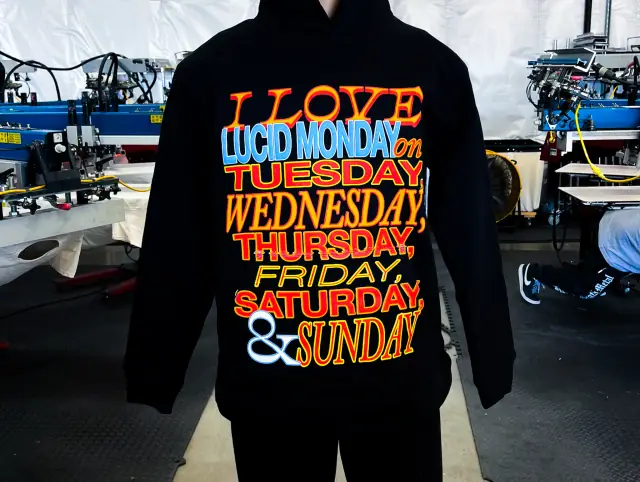
Black hoodie on a form with a large multi-color list of weekdays printed across the chest and kangaroo pocket, presses behind
Merch Mob production

What to know first

Screen printing is a stencil process. A fine mesh is coated with light-sensitive emulsion, the design is burned into it, and ink is pulled through the open areas with a squeegee. Each ink color has its own screen and each print location has its own set, so a design's cost and complexity come down to how many inks it uses and where it prints. On dark shirts most designs need a white underbase first, which counts as one more screen.

Three ideas run through every guide in this section. Setup is fixed and printing is fast, so quantity changes the economics more than anything else. The ink you choose decides the feel and look as much as the art does. And the garment, its fiber, color and cut, limits what ink, size and placement will work.

A reading order

Start with the process. What is screen printing walks through every step from separations to the dryer, including manual and automatic presses. If you are still deciding on a method, types of shirt printing compared sets screen printing beside DTG, DTF, sublimation, vinyl and embroidery.

Choose the look. Screen printing inks explains plastisol, water-based ink and discharge ink: how each cures, feels and suits different fabrics. For a raised effect, read puff print and high-density ink. For sparkle, glow, reflection, foil, suede texture or stretch, read specialty inks.

Get the art right. Preparing artwork for screen printing covers file types, resolution, fonts, Pantone references, separations and what a printer sends back for approval. Spot color vs simulated process vs CMYK explains the three ways to separate a design, and how halftone dots let one ink print shading. The print placement guide gives typical sizes and positions for left chest, full front, back, sleeve and neck prints, and how to size across a run.

Understand feel and quality. Mesh count and print feel explains why two printers can make the same art feel different: mesh, stencil thickness, squeegee hardness, the underbase and the flash cure between colors.

Plan the budget. What drives screen printing cost breaks a quote into setup, quantity, colors, locations, garment, specialty inks, finishing and deadline, and lists ways to cut colors without hurting the design.

Where to go next

For head-to-head decisions, see screen printing vs DTG, screen printing vs embroidery and plastisol vs water-based ink. Prints larger than a standard full front are covered in jumbo and oversized prints. The garment itself has its own section, starting with how to choose a blank. To see the method applied to real products, visit the screen printing page.

Screen Printing Inks & Methods

Every guide in this section

Guide

What Is Screen Printing? How It Works, Step by Step

Screen printing pushes ink through a fine mesh screen onto a garment, using a light-hardened stencil that blocks the mesh everywhere except the design. Each color…

Guide

Types of Shirt Printing Compared: Screen Print, DTG, DTF and More

The main ways to decorate a shirt are screen printing, DTG (direct to garment), DTF (direct to film), sublimation, heat transfer vinyl and embroidery. Screen…

Guide

Screen Printing Inks: Plastisol, Water-Based and Discharge

Most garment screen printing uses one of three ink families. Plastisol is a PVC-based ink that sits on top of the fabric and only cures with heat; it is opaque,…

Guide

Puff Print and High-Density Ink: How Raised Prints Work

Puff print and high-density printing both make a raised print, but in different ways. Puff ink contains an additive that expands with heat in the dryer, giving a…

Guide

Specialty Inks: Metallic, Glow, Reflective, Foil and Suede

Specialty inks change how a print looks or behaves. Metallic and glitter inks carry reflective flakes. Glow ink stores light and releases it in the dark. Reflective…

Guide

Spot Color vs Simulated Process vs CMYK Screen Printing

Spot color prints each color as its own solid ink, which suits logos and flat graphics. Four-color process (CMYK) builds full color from tiny cyan, magenta, yellow…

Guide

Mesh Count, Screens and Why Print Feel Differs

Mesh count is the number of threads per inch in a screen's fabric. Lower counts have bigger openings and lay down thick ink for white underbases, puff and glitter;…

Guide

What Drives Screen Printing Cost (and How Many Colors to Use)

Screen printing cost is mostly setup spread over quantity. Every color in every print location needs its own screen, and a white underbase on a dark shirt counts as…

Guide

T-Shirt Print Placement and Size Guide

On an adult tee, a left chest logo is typically about 3–4 inches wide, a center chest print about 8–10 inches wide, and a full front about 10–12 inches wide with its…

Guide

Preparing Artwork for Screen Printing: Files and Separations

Send vector art (AI, EPS, PDF or SVG) for logos and type, or a raster file at 300 dpi at the final print size for photos and painted art. Outline fonts, name the ink…

FAQ

Screen Printing Inks & Methods: common questions

Is screen printing good for small orders?

It can be, but the fixed setup weighs heavily on a small run, especially with many colors or a dark garment that needs a white base. A one- or two-color design on a light shirt is the most economical small screen printing job. For very small quantities of full-color art, DTG or DTF usually costs less.

What can be screen printed besides t-shirts?

Hoodies, crewnecks, long sleeves, tank tops, tote bags, aprons and many jackets can all be screen printed, as can the flat foam fronts of some trucker caps. The surface needs to sit reasonably flat on a platen, and nylon, polyester and heavy fleece may need special inks or settings.

What makes a screen print feel soft?

Less ink on the surface. Water-based and discharge inks soak into cotton instead of sitting on top, finer mesh lays down thinner layers, and avoiding a heavy white base on a dark garment removes the thickest layer. Fewer large solid areas in the design also make the finished shirt feel lighter.

How long does it take to get screen printed merch made?

Timing depends on the run size, number of colors and locations, blank availability, finishing and whether a test print is needed. Artwork approval is often the step that slows a project most, so having print-ready files and decisions on ink colors and placement speeds everything up.

Need it made?

Turn the plan
into product.

Tell us what you are making. You get a line-item quote, an honest timeline and production advice within 24 hours.

Email the shop
24 hours quote responseSo Cal productionClients across the US and worldwideDigital mockup before anything runs