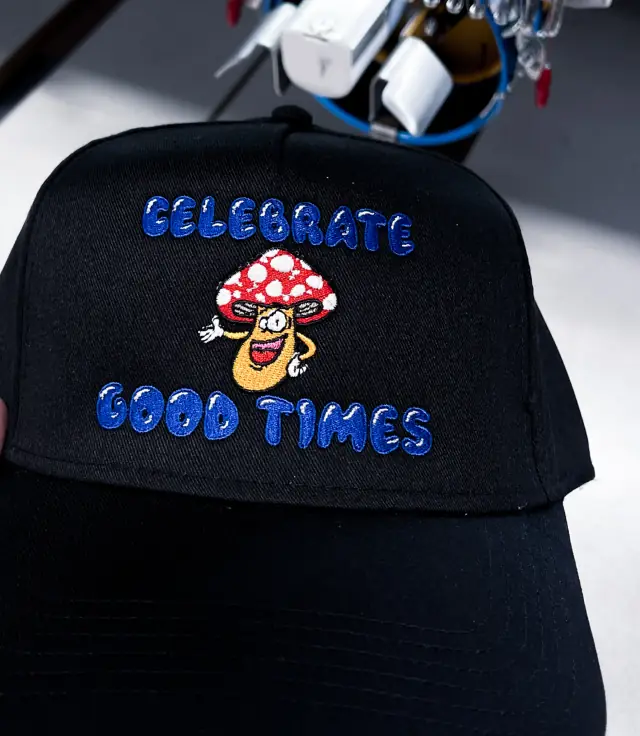
Start here
Embroidery builds a design out of thread instead of ink. A machine drives a needle through the garment hundreds of times a minute, locking a colored top thread to a bobbin thread underneath, and the path of every stitch comes from a digitized file made for that design at that size. Because the image is made of thread, it has texture, depth and sheen that print cannot copy. It also has limits: thread cannot shade the way ink can, tiny text closes up, and thin or stretchy fabric puckers under a dense design.
Read the guides in this order
- How machine embroidery works: the machine, hooping, backing, the three basic stitch types, and which designs and fabrics behave. Read this first, because the other guides build on it.
- Embroidery digitizing: how a logo becomes a stitch file, why underlay, density and pull compensation decide the result, and why caps need their own file.
- Stitch count and pricing: why stitches set most of the cost, typical counts by placement, and how to bring a count down without hurting the design.
- Embroidery thread: polyester, rayon, metallic and hand-embroidery floss, what thread weights mean, and how colors get matched.
- Flat, 3D puff and chain stitch: the three looks a merch order usually chooses between, and the machines behind them.
- Custom patches: embroidered, woven, PVC and chenille patches, borders and backings, and when a patch beats stitching straight onto the garment.
Where embroidery fits in a merch line
Embroidery earns its place on things people keep and wear often: caps, beanies, polos, fleece, jackets and heavyweight crewnecks. A small left-chest mark on a hoodie or a stitched front on a structured cap reads as a step up from a printed tee, so many lines pair a printed graphic tee with one or two embroidered pieces. For large, colorful or photographic art, printing is usually the better tool; screen printing vs embroidery sets the two side by side.
Hats have a pillar of their own because cap construction changes so much: start with hat decoration options and cap profiles and fits. Raised lettering also has its own section, beginning with what 3D puff embroidery is. Knit hats are covered in beanie decoration.
Words worth knowing first
A handful of terms come up on every embroidery quote. Digitizing is the work of turning artwork into machine instructions. Stitch count is the number of needle penetrations in that file, and it drives machine time. Backing is the stabilizer hooped behind the fabric to hold it still. A satin stitch is the smooth, glossy stitch used for lettering and borders, and a chain stitch is the looped line behind vintage script names on work shirts.
What to have ready before asking for a quote
- Artwork as a vector file or a large, clean image, plus the finished size in inches.
- The garment or cap style, its color and its fabric.
- Every placement: left chest, cap front, sleeve, back.
- Thread colors as Pantone references or thread chart numbers, if you have them.
- Whether any element should be raised (3D puff) or metallic.
- Quantities per size and color.