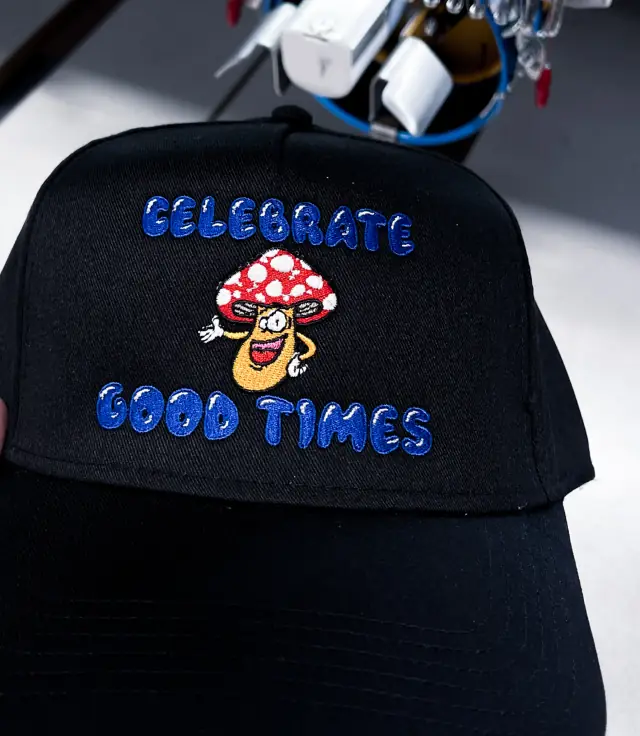
The three styles side by side
Most embroidered merch uses one of three looks, and each comes from a different way of putting thread on fabric.
| Flat embroidery | 3D puff embroidery | Chain stitch embroidery | |
|---|---|---|---|
| Built from | Running, satin and fill stitches | Satin columns stitched over foam | Interlinked loops of thread |
| Machine | Standard lockstitch embroidery head | The same head, plus a foam layer | Hand-guided chain stitch machine or a computerized chenille machine |
| Surface | Smooth and glossy, slight relief | Raised, rounded, sculptural | Textured, rope-like lines |
| Detail | Highest; small text and fine lines | Low; bold shapes only | Medium; flowing lines and script |
| Typical use | Logos on polos, caps, fleece, jackets | Short words and simple icons on cap fronts | Script names, western and varsity looks |
| Consistency | Identical piece to piece | Identical piece to piece | Hand-guided pieces vary slightly |
Flat embroidery
Flat embroidery is what most people picture: a lockstitch machine laying down running, satin and fill stitches from a digitized file. It is not truly flat, since satin columns sit slightly proud of the fabric and catch the light, but nothing is padded underneath. That makes it the most versatile of the three. It holds lettering down to about a quarter of an inch, handles a dozen or more thread colors, and works on caps, polos, fleece, jackets, beanies and bags. Corporate polos, left-chest hoodie logos and most cap sides and backs are flat.
Its limits are those of embroidery in general (tiny text, gradients, huge solid fills), covered in the how embroidery works guide. Because it is the baseline, the other two styles are often combined with it: a puff word with a flat tagline, or a chain-stitched script beside a flat logo.
Flat embroidery is also more than one look. The same lockstitch head can produce:
- Textured fills: patterned fills that carve lines or motifs into a filled area, adding interest without adding color.
- Emboss effects: channels stitched into a fill so a logo appears pressed into a solid field, a subtle tone-on-tone look on polos and fleece.
- Appliqué: a piece of fabric stitched down and edged in satin, covering a big area with far fewer stitches than fill.
- Tackle twill: cut twill letters and numbers stitched down with a zigzag or satin edge, the classic jersey and varsity treatment.
- Tone-on-tone: thread a shade off the garment color, which reads as quiet and premium on dark fleece and caps.
3D puff embroidery
3D puff raises a design by stitching dense satin columns over a sheet of embroidery foam laid on the fabric. The needle perforates the foam along every edge, the loose foam is torn away, and what is left is a padded, rounded shape that stands well off the surface. It is the signature look of the structured snapback and the bold dad-hat word mark.
Puff has firm design rules: bold shapes, satin columns within a workable width, no small text and no fine detail. Those rules, foam colors and how the file is built are covered in what 3D puff embroidery is. Where it works best, and why structured cap fronts suit it better than most garments, is in 3D puff on hats vs garments. If you are weighing raised thread against raised ink, read puff embroidery vs puff print.
Chain stitch embroidery
How a chain stitch forms
A chain stitch is a line of loops, each one pulled through the loop before it. There is no bobbin. A hooked needle reaches through the fabric, catches thread fed from below, and pulls a loop up through the previous loop, so the chain builds on the face of the fabric while the back shows a plain line of thread. Each chain link is wider and more textured than a lockstitch running stitch, so a single line of chain stitch reads boldly from a distance. Filled areas are built from rows of chain packed side by side, often following the outline of a shape inward, which gives chain stitch fills their distinctive swirl.
Hand-guided machines
The industrial chain stitch machine dates to the early 1860s, when Antoine Bonnaz developed the first successful one. Ercole Cornely later acquired the Bonnaz patent and developed a hook-shaped needle for it, and the machines became known as Cornely machines. On this kind of machine, the operator turns a handle under the table to steer the direction of stitching while moving the fabric freehand to follow a drawn design. Handle-operated machines of this type, such as the Singer 114W103 and modern reproductions of it, are still in use.
Hand-guided chain stitch is closer to drawing than to running a file. Each name, script or illustration is stitched by an operator, so no two pieces are quite identical, and the result has a warmth that digitized embroidery does not. That is why it shows up on work shirt name patches, western yokes, bowling shirts, varsity jackets and one-off customization at pop-up events. The trade-off is speed and consistency: output depends on one skilled person, and every piece takes real time.
Computerized chain stitch
Chain stitch can also be run from a digitized file. Tajima's TCMX chenille machines, for example, make both a loop stitch, pulled up with a crochet hook, and a chain stitch, and they can pair chenille heads with standard embroidery heads on one machine. Tajima rates chenille stitching on most of the series at up to 750 stitches per minute, against 1,000 for the standard heads on its mixed machines. Computerized chain stitch repeats a design exactly across a run, which suits brand orders where every jacket must match, though it loses some of the hand-drawn variation that buyers of chain stitch often want.
Durability and care
Chain stitch wears well, but its structure gives it one weakness. Each loop is held by the next, so if a loop is cut or broken and the thread end is free, a line can pull out like a ripcord. Good operators secure the start and end of each line. Treat finished pieces kindly: wash inside out, keep them away from hook-and-loop fasteners, and avoid rough drying cycles that can snag loops.
Moss stitch and chenille
The same family of machines makes chenille. When the hooked needle pulls loops up through the fabric and leaves them standing rather than chaining them, it creates a moss (loop) stitch, a dense, terry-like pile. Pack enough of it inside a chain-stitched outline and you have the fuzzy lettering of a varsity letter. This is how chenille patches are made, usually on felt, and the custom patches guide compares them with embroidered, woven and PVC patches.
Choosing a style for your design
- A small logo with fine detail or several colors: flat.
- A short, bold word or a simple icon on a structured cap front: 3D puff.
- A script name, signature or hand-drawn lettering with a vintage or workwear feel: chain stitch.
- Big, fuzzy varsity letters or a retro crest: chenille with chain-stitched outlines, usually as a patch.
- A mix: puff on the main word with flat details, or chain-stitched script beside a flat logo.
| Garment | Flat | 3D puff | Chain stitch |
|---|---|---|---|
| Structured cap | Excellent | Excellent | Possible, on suitable fronts |
| Unstructured cap | Excellent | Limited, the panel collapses | Possible |
| Polo or work shirt | Excellent | Rarely | Excellent for names and scripts |
| Hoodie or fleece | Excellent | Possible with care | Good on heavy fleece |
| Jacket | Excellent | Possible on stiff shells | Classic on varsity and chore jackets |
| Lightweight tee | Small designs only | Not suited | Small, light lines only |
Artwork that suits each style
The same logo often needs different artwork for each style.
- For flat embroidery, send a clean vector logo. Keep lettering at about a quarter inch tall or more, satin strokes at least about 1 mm wide, and colors solid. The digitizing guide lists everything a digitizer needs.
- For 3D puff, expect thin strokes to be thickened and small elements to be stitched flat or dropped. Send the word mark on its own if the full logo carries a tagline or fine icon.
- For chain stitch, think in lines. Script lettering, signatures and single-line drawings translate best. Each chain line is wide, so leave generous space between strokes and inside loops of letters such as e, a and o, or they will merge. Draw the design at actual size, because what fits on paper at 8 inches will not fit on a 4-inch chest.
Hand-guided chain stitch machines typically carry a single needle, so each extra color means stopping to re-thread. Chain stitch designs therefore tend to stay with a few colors, which suits the look anyway. Fills are possible but slow, so a design with large solid areas may be better as a chenille patch or as flat embroidery with a chain-stitched script on top.
Cost and lead-time drivers
Each style prices differently. Flat embroidery follows stitch count and machine time, as the stitch count and pricing guide explains. 3D puff adds foam, a specialist file and slower stitching on the raised parts. Hand-guided chain stitch is priced more like skilled handwork: time per piece is set by the operator, so large quantities scale in a straight line rather than getting much cheaper per piece. Computerized chain and chenille work depends on access to machines that fewer shops own.
Before ordering chain stitch, ask whether it will be hand-guided or computerized, whether you can see a stitched sample of similar lettering, what thread or yarn will be used, and whether fills are possible or only lines. For puff, ask how the design will be adapted to puff's width rules. For flat work, ask for the stitch count once the file is digitized.
Sources
- Textile Research Centre Leiden, Cornely machine, checked 2026-10-04
- Tajima, TCMX series chenille embroidery machines, checked 2026-10-04
Useful for: clothing brands, restaurants and bars, events, skate and surf shops.