What a stitch count is
Every time the needle goes down, that is one stitch. Digitizing software totals them, including underlay, travel runs and tie-ins that never show on the front, and prints the figure on the design's work sheet. Two logos that look alike can differ by thousands of stitches because one uses an open fill and the other dense satin, or because one file carries heavy underlay for fleece and the other is set up for twill.
That makes the stitch count a property of the file, not of the artwork. Ask for it once a design has been digitized at its final size, and ask again whenever the size changes.
Before a file exists, a shop can only estimate. Experienced digitizers judge from the art (how much is solid fill, how much is lettering, how many separate elements), and some software estimates a count from an image. Estimates are usually close for simple logos and loose for complex ones, so a quote built on an estimate may be adjusted once the real file is made.
The garment nudges the count as well. Fleece and terry need heavier underlay so stitches ride above the pile, which adds stitches. Performance polyester is usually digitized lighter to limit puckering, which removes some. Caps often carry a little more underlay than flats. That is one more reason the cap version and the flat version of a logo rarely share a count.
Why stitches turn into price
Embroidery machines run at a fairly steady speed, so stitches convert into minutes. Depending on the model, commercial machines are rated at about 1,000 to 1,500 stitches per minute on flat goods and less on caps; Tajima's TMBP2-SC, for example, is rated at 1,200 on flats and 1,000 on caps. Production usually runs below that ceiling. Take an 8,000-stitch logo at an assumed 800 stitches per minute: ten minutes of sewing, plus color changes, trims, hooping and unhooping. A 40,000-stitch jacket back on the same machine ties up a head for close to an hour. On a multi-head machine every head is busy with the same design, so a long run time holds up the whole job, not one garment.
That is why many shops price embroidery in stitch-count bands: a base band that covers a typical small logo, then a step up for each additional block of stitches. Others quote by size category (small, medium, large), which is stitch count by another name. Either way, the machine minutes and the labor around them are what you are paying for. The thread itself is a small part of the cost: Madeira's rule of thumb is about 5 m of top thread and 3 m of bobbin thread for every 1,000 stitches.
Typical stitch counts by placement
Counts vary with the art, the fill and the fabric, so treat these as rough ranges rather than quotes.
| Placement | Typical size | Typical stitch count | What pushes it up |
|---|---|---|---|
| Name or one line of text | 3–4 in wide, letters about 0.5 in tall | 1,000–3,000 | Bold block fonts, outlines |
| Left chest logo | 3–4 in wide | 3,000–10,000 | Solid backgrounds and filled shapes |
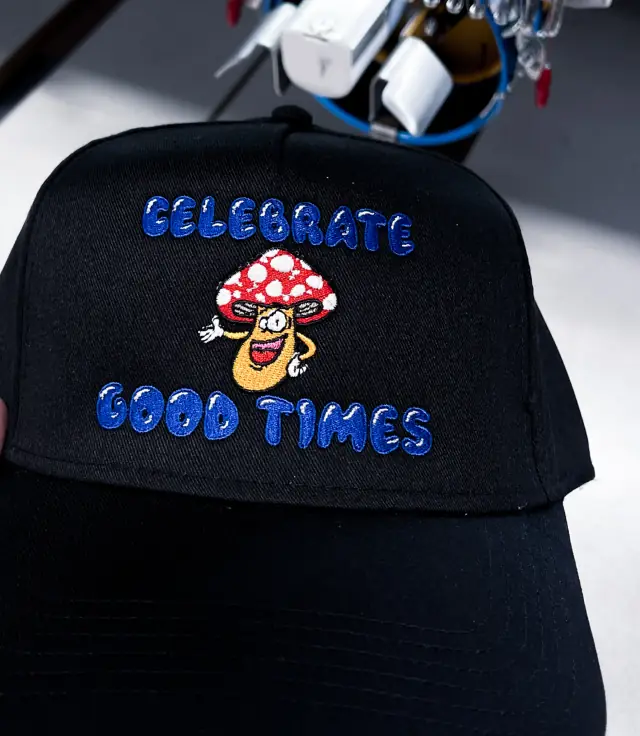
| Cap front | 2–2.5 in tall, 4–5 in wide | 4,000–10,000 | Fill areas, 3D puff, wide designs |
| Sleeve, cap side or cap back | 1–3 in | 1,000–4,000 | Small filled icons |
| Full back on a jacket or hoodie | 10–12 in wide | 20,000–60,000 or more | Large fills and full coverage |
The step from chest to back is bigger than the size change suggests because filled stitches scale with area. Double a filled logo's width and height and its fill stitches roughly quadruple. Satin lettering grows more gently, roughly in step with the total length of the strokes, which is why a big word in outline lettering can cost less than a small solid crest.
Working out machine time for a run
Machine time for a whole order follows from three numbers: stitches per piece, running speed, and how many heads stitch at once. Here is an illustration with assumed figures, not a quote:
- The order is 144 hoodies with one 7,000-stitch left-chest logo, on a six-head machine.
- At an assumed 750 stitches per minute, each cycle of six hoodies sews for a little over nine minutes.
- Allow about two more minutes per cycle for color changes, trims and swapping hoops, since operators usually hoop the next set while the machine runs.
- 144 hoodies across six heads is 24 cycles, so the job needs roughly four and a half hours of machine time.
Now add a 30,000-stitch back design to the same hoodies. Every piece needs a second hooping, and each cycle grows by about forty minutes of sewing. The order goes from an afternoon on one machine to something that fills several shifts. That is why extra placements and big back designs move both the price and the lead time, and why a quote changes so much when a back hit is added or dropped.
Everything else that moves the price
| Driver | Why it costs | How to keep it down |
|---|---|---|
| Digitizing | Skilled set-up time for each design, and for each version (cap and flat) | Reuse one approved file across orders and keep the native file |
| The item | The blank or cap itself; bags and thick jackets are slow to hoop | Choose items that hoop easily |
| Placements | Every location is a separate hooping and a separate run | Fewer placements, or one stronger mark |
| Thread colors | Each change adds seconds; more colors than needles means re-threading | Merge near-identical shades |
| 3D puff | A foam layer, slower stitching and a dedicated file | Raise one element, not the whole design |
| Metallic thread | Runs slower and breaks more often | Use it as an accent, not a fill |
| Quantity | Set-up spreads across more pieces; hooping time per piece stays | Order the full size run at once |
| Finishing | Trimming, backing removal, folding, bagging and tagging | Specify exactly what you need |
Thread colors are where embroidery differs most from print. In screen printing, every extra color means another screen and more set-up, so colors drive cost. In embroidery, an extra color is just another needle and a few seconds of changeover per piece. A six-color embroidered logo can cost about the same as a two-color one of the same stitch count.
Metallic thread is a good example of a speed penalty: Madeira recommends running its metallics at around 650–750 stitches per minute, well under a machine's rated speed. Raised work adds a foam layer and its own digitizing, as the 3D puff guide explains.
How to lower a stitch count without wrecking the design
- Size it right. A left-chest logo at 3.5 in instead of 4.5 in cuts the filled area by well over a third, and on a polo the smaller size often looks better.
- Knock out the background. Let the garment color act as the background instead of filling a box, circle or badge behind the logo.
- Use outlines and open fills. A satin stitch outline around an empty shape, or a light decorative fill, reads well at a fraction of the stitches.
- Appliqué large shapes. For big varsity-style letters, a piece of twill fabric tacked down with a satin edge covers a wide area with far fewer stitches than a fill.
- Simplify tiny details. Specks, thin gaps and small enclosed shapes add trims and stitches that will not read anyway.
- Move huge designs onto a patch. A custom patch is stitched on stable twill instead of the garment, so a dense design cannot pucker or drag the fabric, and the patch can be made ahead and applied later. It still adds weight and some stiffness where it sits.
What not to cut is underlay or sensible density. A file can be thinned until the count looks great on paper and the fabric shows through the stitching. Ask the digitizer for a smarter structure, not thinner coverage. The digitizing guide explains what a sound file contains.
Questions to ask when comparing embroidery quotes
- Which stitch count, or count band, is the price based on, and what happens if the digitized file comes in higher?
- Is digitizing included, and does a separate cap version cost extra?
- Is there a thread color limit before a surcharge?
- How are 3D puff, metallic thread and appliqué priced?
- Will you see a sew-out photo or sample before production?
- What finishing is included: trimming, backing removal, folding, bagging, tags?
- Are minimums set per design, per item or per order?
Comparing on these points matters more than comparing headline per-piece numbers, because two quotes can assume very different stitch counts for the same logo.
Embroidery cost compared with print
For a small mark, embroidery and printing can land close together, and embroidery often looks more premium for the money on caps, polos and fleece. As artwork grows, the two diverge: embroidery cost climbs with stitched area, while screen printing cost climbs with colors and set-up and falls quickly with quantity. A full-back graphic is almost always cheaper printed; a left-chest logo on a heavy hoodie is often worth stitching. Screen printing vs embroidery compares the methods side by side, and the pricing and margins guide shows how to fold decoration cost into a retail price.
Sources
- Tajima TMBP2-SC embroidery machine specifications, checked 2026-10-04
- Melco, Comparison of embroidery machines, checked 2026-10-04
- Madeira USA, Digitizing density guide (thread use per 1,000 stitches), checked 2026-10-04
- Madeira, How to stitch with metallic embroidery threads, checked 2026-10-04
Useful for: companies, clothing brands, events, restaurants and bars.