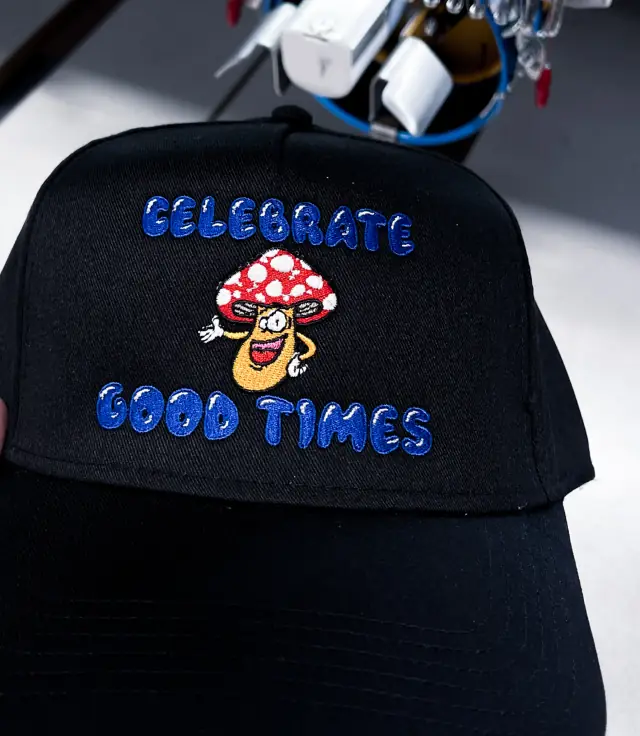
Hand embroidery thread vs machine embroidery thread
If you are stitching by hand, you want floss. Six-strand cotton floss is the standard: DMC's Mouliné Spécial, for example, is 100% cotton, mercerized twice for sheen and sold in 8 m (8.7 yd) skeins in 500 shades. The six strands pull apart, so you choose the thickness of every line: two strands for fine detail and cross-stitch, all six for a bold, raised stitch. Perle (pearl) cotton is the other staple, a twisted thread that does not separate. DMC sells it in sizes 3, 5, 8 and 12, with size 3 the thickest, and it suits bold outlines, sashiko-style running stitch and visible mending. Crewel wool and silk cover more specialist work.
Machine embroidery thread is a different product. It is finer and smoother, wound on spools or cones of 1,000 m and up for long runs at high speed, and it is almost always polyester or rayon in 40 weight. Floss will not run through an embroidery machine's needle and tension system, and machine thread used by hand feels thin and slippery for most stitches.
| Thread | Used for | Construction | Notes |
|---|---|---|---|
| Stranded cotton floss | Hand embroidery, cross-stitch | Six loose strands, divisible | Separate strands for finer lines |
| Perle cotton | Hand embroidery, sashiko-style stitching | Twisted, not divisible; sizes 3 to 12 | Size 3 thickest, size 12 finest |
| Polyester machine thread | Commercial and home machines | Continuous filament, two plies | Strong; bleach-resistant types exist |
| Rayon machine thread | Commercial and home machines | Viscose filament | Soft and glossy; keep away from bleach |
| Metallic thread | Machine accents, some hand work | Metallized film around a core | Slower stitching, rougher feel |
For a home embroidery machine, start the way a commercial machine does: 40 weight polyester or rayon on top, a 75/11 embroidery needle and a lighter bobbin thread underneath. Single-needle home machines stop at every color so you can re-thread, which makes the number of colors a question of patience rather than cost.
Polyester vs rayon
For machine embroidery, these two fibers do nearly all the work, and they look more alike than most buyers expect.
Rayon (viscose) is regenerated cellulose made from wood pulp. It is soft, lies flat and spreads a little as it stitches, which gives generous coverage and a deep, silky shine. Its weak point is chemicals and light: Madeira states that its Classic rayon is not bleach-resistant and that long exposure to bleach, chlorine or UV light can fade it.
Embroidery polyester is a continuous filament that is stronger and more abrasion-resistant than rayon and holds color through harsh washing. Madeira's Polyneon, for example, is tested against a defined chlorine bleach treatment and sold as the first choice for frequently washed and industrial textiles, with a sheen Madeira describes as almost as high as its rayon. That narrowing of the looks gap is why most commercial merch is now stitched in polyester.
| Polyester | Rayon | |
|---|---|---|
| Sheen | High, slightly glassier | Very high, silky |
| Hand | Smooth, a touch firmer | Soft and supple |
| Strength | Higher, with fewer breaks at speed | Lower |
| Chlorine bleach | Bleach-resistant types available | Fades or weakens |
| Sunlight | Holds color well | Can fade with long exposure |
| Best for | Uniforms, workwear, caps, kids' clothes, anything washed hard | Fashion pieces, delicate fabric, a deliberately soft look |
Cotton machine thread exists too, with a matte, vintage look, and matte polyester gives a similar flat finish with polyester's toughness. Both are useful when shine would look wrong, such as a washed-out heritage logo.
Thread weight: what 30, 40 and 60 mean
Embroidery thread weight is a length-per-mass measure, so a higher number means a finer thread. In principle, 40 weight means 40 km of thread weighs 1 kg. In practice the label is a trade convention: a typical 40 weight embroidery thread is about 120 denier in two plies, close to tex 27, which does not match the formula exactly. When you switch makers, compare tex or denier rather than the weight label alone.
| Weight | Approx. denier | Approx. tex | Typical needle | Use |
|---|---|---|---|---|
| 12 wt | 360/2 | 80 | 90/14–100/16 | Heavy, hand-stitched look |
| 30 wt | 150/2 | 35 | 80/12–90/14 | Bold outlines and heavy fabric |
| 40 wt | 120/2 | 27 | 75/11 | Standard for almost all embroidery |
| 60 wt | 75/2 | 17 | 70/10–75/11 | Small lettering and fine detail |
| 70 wt | 60–65/2 | 14 | 65/9–70/10 | Tiny lettering, delicate work |
Figures in the table follow Wilcom's published thread and needle chart. Weight and file go together: a design digitized for 40 weight and stitched in 60 weight shows gaps, while the same file in 30 weight packs up stiff and breaks needles. Wilcom's rule is to open up density for heavier threads and tighten it for finer ones. Finer thread is how small text gets possible: AMANN pitches its 60 weight polyester at lettering around 4 to 5 mm tall and its 75 weight at micro lettering of about 3 mm.
Bobbin thread is lighter again, commonly around 60 weight polyester in white or black. On items where the inside shows, such as an unlined jacket or a towel, matching the bobbin color to the fabric keeps the back tidy.
For planning how much thread to buy, Madeira's digitizing guide gives a useful rule: roughly 5 m of top thread and 3 m of bobbin thread for every 1,000 stitches. A 10,000-stitch design therefore draws about 50 m of top thread, shared across its colors, so a single 1,000 m spool covers a surprising number of home projects. The stitch count shown in your embroidery software or design listing is the number to multiply.
Metallic and specialty threads
Metallic embroidery thread is a thin metallized film wrapped around a core thread. It gives a real glint that no print fully matches, and it is fussy to run:
- Slow down. Madeira recommends 650–750 stitches per minute for its metallics, well below a commercial machine's top speed.
- Change the file. Metallics run best in designs with lower density and no sharp angles, so a logo usually needs a metallic-specific version.
- Fit a fresh needle. A new needle with a larger eye reduces shredding.
- Keep it to accents. Outlines, lettering and small crests suit metallic. Large fills feel scratchy against skin, especially inside a cap or on a chest logo without a soft backing.
- Wash gently. Cool water, inside out, no bleach, and press from the back so the iron never touches the metallic film.
Other specialty threads follow the same pattern of testing and slower running: glow-in-the-dark, UV color-changing, flame-resistant thread for workwear, variegated thread that shifts color along its length, and wool blends for a hand-made, matte look. Each can be striking on a small element, and each needs a sew-out before a full run.
Choosing thread for the item
The garment and how it will be treated matter more than any brand preference.
| Item | Thread choice | Why |
|---|---|---|
| Chef coats, aprons, work shirts | 40 wt polyester | Commercial laundries and bleach; see restaurant and bar merch |
| Caps | 40 wt polyester | Sweat, sun and no washing machine to rescue them |
| Team kits and kids' clothes | 40 wt polyester | Hot, frequent washes; see sports team merch |
| Towels and robes | 40 wt polyester, plus topping | Bleach, and pile that swallows stitches |
| Polos with small text | 60 wt polyester for the lettering | Open counters and crisp letters at small sizes |
| Fashion knits and delicate fabric | Rayon | Softer hand and a silkier shine |
| Patches | 40 wt polyester | Toughness on an item that gets handled; see custom patches |
| Hand-stitched personalization | Cotton floss or perle cotton | The textured, hand-made look buyers want |
For merch, the safe default is polyester for anything that gets washed, worn outside or handled hard, with rayon reserved for pieces where softness and shine are the point. The how embroidery works guide explains backing and topping, and the digitizing guide covers how a file is tuned to its thread and fabric. Both satin and fill areas show the difference between thread types most clearly, since long satin stitches catch the most light.
Matching thread colors
Thread is dyed to each maker's own color numbers, so the first step is choosing a thread line and working from its chart. Thread makers publish Pantone conversions that suggest the nearest thread for each Pantone color. Madeira, for one, offers a Pantone matching tool, says exact matches cannot be guaranteed, and recommends approving a stitched sample before a full order. Treat any conversion as a starting point:
- Shine shifts color. Thread reflects light and printed ink does not, so the same color reads lighter or darker depending on the angle you look from.
- Stitch direction shifts it too. Two areas in the same thread at different angles can look like two shades.
- Some colors are hard. Neons, certain reds and very dark navies may have no exact thread match.
- Check a physical sample. A thread card or a sew-out photo in daylight beats any screen.
- Record the numbers. Once a color is approved, write down the thread maker and color number so reorders match.
If your brand color is a Pantone spot color, pass the reference along with the art, and ask which thread number has been chosen for it.
How many colors a design can have
Each color occupies a needle. Commercial heads commonly carry 12 to 15 needles, so a design up to that range runs without stopping; beyond it, the operator pauses and swaps cones. Extra colors add changeover time, not set-up, which makes them far cheaper than extra ink colors in screen printing. The real cost of a busy palette shows up elsewhere: more small separate areas, more trims, and more chances for colors to drift out of register. Shading can often be suggested with stitch direction or by layering two close threads, rather than by adding five tints. The stitch count and pricing guide covers what colors and stitches do to cost, and flat, 3D puff and chain stitch shows how thread choice changes with each stitching style.
Sources
- DMC, Six-Strand Embroidery Floss (Mouliné Spécial), checked 2026-10-04
- DMC, Pearl Cotton, checked 2026-10-04
- Wilcom, Thread thickness and needle size, checked 2026-10-04
- AMANN, Small embroidery designs: precision starts with the right thread, checked 2026-10-04
- Madeira, Polyneon 40 product page, checked 2026-10-04
- Madeira UK, Classic 40 rayon product page, checked 2026-10-04
- Madeira, How to stitch with metallic embroidery threads, checked 2026-10-04
- Madeira UK, Pantone conversions, checked 2026-10-04
- Madeira USA, Digitizing density guide (thread use per 1,000 stitches), checked 2026-10-04
Useful for: companies, clothing brands.