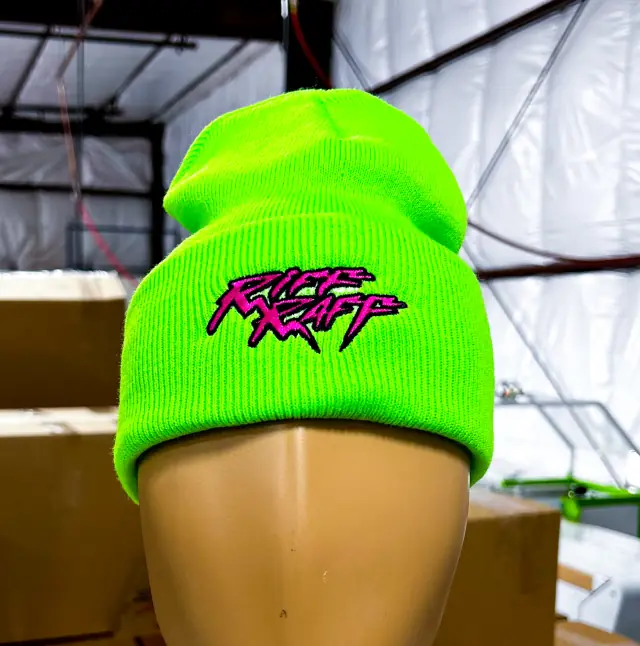
Four ways to brand a beanie
| Method | How it is made | Look | Works best for | Watch out for |
|---|---|---|---|---|
| Direct embroidery | Stitched into the cuff or body of a stock beanie | Textured, colorful, durable | Bold logos and short words | Stretch, rib texture, small detail |
| Sewn patch | A separate woven, leather-look, embroidered or PVC badge sewn on | A badge with crisp edges | Detailed art, a retail look | Sewing so the cuff still folds |
| Knit-in (jacquard) | The logo is knitted into the fabric | Flat, part of the knit itself | Custom programs, patterns, stripes | Custom run, minimums, lead time |
| Woven label | A small label sewn on the cuff or into a seam | Quiet, retail finish | Fashion lines, tonal branding | Small size, little impact from afar |
The first two work on stock beanies from blank makers. Knit-in needs a beanie made to order. Labels can go on either.
Embroidering on the cuff
How the cuff is stitched
On a cuffed beanie, the decorator unfolds the cuff and hoops only the single layer that will face out once it is folded back. The design is sewn upside down relative to the beanie's body, so it reads the right way up after folding. That keeps the back of the stitches and the backing hidden inside the fold, away from the wearer's forehead and out of sight. Stitching through both layers would lock the cuff shut and leave the reverse of the design showing inside.
Uncuffed beanies have no fold to hide behind. The logo goes on the single-layer body a little above the bottom edge, and the back of the embroidery rests on the forehead. A soft backing, trimmed close, keeps that comfortable; some decorators add a soft fusible cover on the inside.
Fleece-lined beanies add a layer to think about. On a style such as the 82-1317 from Otto Cap, a 9-inch acrylic knit with a polyester fleece lining, stitches usually pass through both the knit and the lining, so the back of the design shows on the fleece inside. Ask how the inside will be finished, or choose a cuffed style where the fold hides it.
Stretch, backing and topping
Knit moves. If the beanie is stretched as it is hooped, it springs back after sewing and the design puckers or warps. Hooping the knit relaxed, with a stabilizer behind it, keeps the shape true. Many decorators also lay a thin water-soluble topping on the face so stitches sit on top of the ribs instead of sinking between them; it rinses or tears away after sewing.
The file matters too. A logo digitized for a firm cap or a polo usually needs changes for a knit: more underlay to give the stitches a base, adjusted density, and compensation for the way the ribs pull. Ask whether the beanie version gets its own file.
Size and detail
The design has to fit inside the visible cuff with room above and below. On a standard cuff, designs commonly end up about 2 inches tall, and less on the short cuff of a fisherman beanie. Measure the cuff on the actual style before the art is sized, because cuff heights vary between makers.
Detail is the real limit. The ribs break up thin lines, and small text that would hold on a cap sinks into the knit. Keep lettering bolder and a little larger than on a hat, use satin stitch letters over thin outlines, and keep colors to the few that matter. Very dense fills are also a mistake: they turn the cuff stiff and can make the knit bulge around the design.
Knit density changes all of this. Yupoong markets its 1501KC cuffed beanie as densely knit for easy embroidery and its 1545K ribbed cuffed beanie as loosely knit. The first gives stitches a firm base; the second suits a patch or a very bold mark. Beanie styles and fabrics covers knit types and yarns.
3D puff on beanies
3D puff embroidery is possible on a dense cuff with bold, simple shapes, but the stretch and the fold work against it: the raised edges soften and the cuff stiffens. It looks crisper on a structured cap, as 3D puff on hats vs garments explains.
Patches on beanies
A patch moves the detail off the knit. The art lives on the patch's own surface, so fine lettering and small shapes survive, and the beanie only has to hold a border of stitches.
- Woven patches are thin, flexible and hold the finest detail. They bend with the cuff and suit fashion and retail lines.
- Leather-look and genuine leather patches are debossed or laser-etched, usually in one tone. They give an outdoor or workwear feel.
- Embroidered patches give the classic stitched badge with a raised border, without punching a dense fill into the knit.
- PVC or rubber patches are bold and weatherproof but stiff, so keep them small on a cuff that has to fold.
Sewing is the dependable default. Heat and pressure can flatten the knit or glaze acrylic, and adhesive grips a loose, stretchy rib poorly. Heat-applied patches can work on some dense knits with a suitable adhesive and a press set up for beanies, but test one first, and check the blank maker's guidance: Richardson's page for its 137 cuffed beanie rules out transfers and heat-pressed felt or twill appliqué for that style. When sewing, the decorator stitches through the outer layer of the unfolded cuff so the cuff still turns down freely and the stitching stays hidden. Custom patches covers patch types, borders and backings in depth.
Knit-in logos
A knit-in, or jacquard, logo is knitted into the beanie while it is made. The knitting machine switches between yarn colors stitch by stitch, so the design is built from the fabric itself rather than added on top. It cannot crack or peel like surface decoration (though a loop or an inside float can still snag on a ring or zipper), and it can cover the whole beanie with stripes, patterns or repeating marks.
It comes with trade-offs. Art is drawn on a grid of stitches, so curves step, diagonals look jagged and small text breaks apart; bold shapes and blocky type work best. The number of yarn colors per row is limited by the machine, and on many jacquard knits the unused yarns float across the inside, which some makers cover with a lining. Above all, knit-in needs a custom production run: yarn colors chosen and matched, samples knitted and approved, and a factory minimum order. That brings a much longer lead time than decorating stock beanies. Blanks vs cut and sew explains the wider trade-off, and when to order custom beanies covers the timing.
Labels and finishing details
A small woven label does a lot on a beanie. Sewn on the side of the cuff, or folded into a seam as a flag label, it gives a retail finish with almost no impact on the knit. Tonal labels (same color as the beanie) look premium; contrast labels read from further away.
Inside the beanie, a sewn label can carry the brand name and care instructions, and a hang tag presents it on a retail shelf. Private label finishing covers what labels typically include and how relabeling works.
Choosing by look and quantity
| Situation | Usual fit |
|---|---|
| A simple logo on stock beanies, any run size | Direct embroidery on the cuff |
| Detailed art, small text or many colors | A sewn woven patch |
| A rugged, outdoor or workwear look | A leather or leather-look patch |
| A fashion drop with subtle branding | A woven label on the fold, or small tonal embroidery |
| A fisherman beanie with a short cuff | A compact stitched mark or a small woven label |
| Custom colors, stripes or an all-over pattern in a large program | A knit-in logo |
Stock beanie decoration scales down to small runs; knit-in programs only make sense at volume.
Proofs and checks before the run
- Measure the cuff on the actual style and size the design to it, with margin top and bottom.
- Approve a mockup that states the cuff depth, so the logo sits where you expect when the beanie is folded.
- Match thread or patch colors to the yarn, using a physical sample where possible; dark knits swallow dark thread.
- Ask for a sew-out on the real beanie and check the inside: the back of the design should be hidden in the cuff or neatly finished.
- Stretch the sample gently. Embroidery that cracks the knit open or a patch that puckers the cuff will look worse after a season of wear.
For how embroidery works in general, see how machine embroidery works.
Sources
- Richardson 137 Heathered Beanie with Cuff product page (decoration notes), checked 2026-10-04
- YP Classics 1501KC Cuffed Knit Beanie (Flexfit), checked 2026-10-04
- YP Classics 1545K Ribbed Cuffed Knit Beanie (Flexfit), checked 2026-10-04
- Otto Cap 82-1317 9" Classic Knit Beanie w/ Inside Fleece Lining, checked 2026-10-04
Useful for: clothing brands, companies, sports teams, schools and clubs.