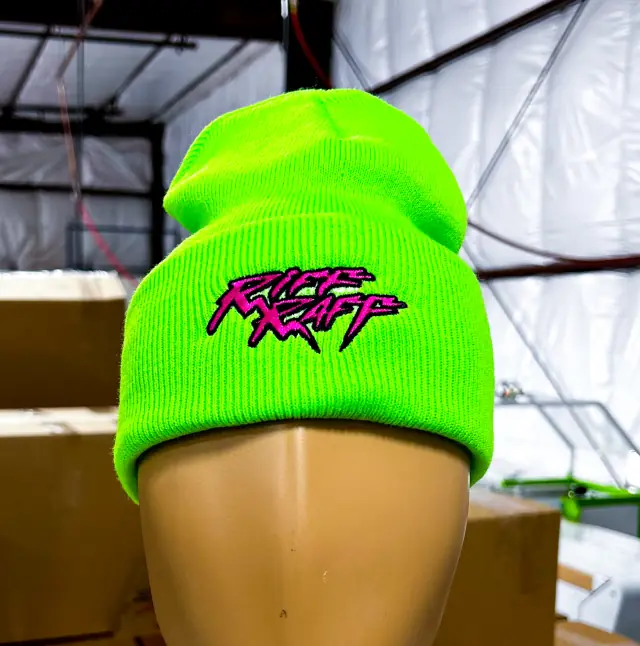
Why beanie timing works differently
Most merch sells all year. Beanies do not: nearly everyone who wants them wants them for the same few cold months. Brands planning winter drops, companies buying holiday gifts, teams outfitting for the season, ski and snow events, and bands heading out on winter tours all order around the same time.
That crowding shows up in two places. The first is blank stock. Distributors carry finite inventory of each beanie style and color, and the core colors (black, navy, heather grey and the like) draw down as fall goes on. The second is production. Embroidery machines and decorators' schedules are busiest in the run-up to the holidays, exactly when late orders arrive.
Neither of these is a reason to panic. They are reasons to order earlier than you would for tees, and to decide in advance what you will do if your first choice runs out.
Stock beanies vs custom-knit beanies
Beanie orders come in two very different kinds, and their timelines are not in the same scale.
| Decorated stock beanies | Custom-knit beanies | |
|---|---|---|
| What you get | A maker's existing style and colors, embroidered, patched or labeled | Your own knit, colors, length and knit-in logo or pattern |
| What sets the timeline | Blank stock, artwork and digitizing, mockup and sew-out approval, production, shipping | Yarn colors, sample rounds, factory slot, knitting, freight |
| Scale of lead time | Weeks | Months |
| Main risk | Your color selling out | A slow sample round or delayed freight |
| Minimum order | Set by the decorator | Set by the knitting factory, usually much higher |
| When to start | Early fall for winter use | Spring or early summer for winter use |
Decorating stock beanies is covered in beanie decoration. For a knit-in program, the drivers are the same as any made-to-order product: MOQs and timelines in clothing production explains why factory minimums exist and what stretches a schedule.
The seasonal calendar
Specific dates depend on your climate and your event, but the order of things is predictable in most of the US:
- Spring to early summer: brief and sample custom-knit programs for the coming winter. This is also a good time to lock in a stock style and colorway for a big fall order.
- Late summer: finalize artwork, get logos digitized for the beanie version, and approve mockups while decorators are less busy.
- Early fall: place orders for stock beanies needed for fall drops, team seasons and early cold-weather events. Core colors are still easy to find.
- Mid to late fall: holiday gifting and winter launches converge. Orders placed now still work, but with less room for a sold-out color or a second sew-out.
- Winter: reorders and late requests. Stock on popular styles can be thin, so expect substitutions to come up more often.
- Late winter: retail demand fades. Ordering a large quantity this late risks holding stock until next season.
Buyers in warm climates still need beanies for ski trips, mountain events and holiday gifts, so the same calendar applies even where it never snows.
Planning backward from your date
Work from the date the beanies must be in your hands, not the date they ship. Then subtract each step in turn:
- In-hand date. The event, the launch or the day gifts go out.
- Shipping and a buffer. Carrier time to you, plus slack for weather delays, which matter more in winter.
- Production. The decorator's quote sets this; ask for it in writing.
- Sew-out approval. A test stitch on the actual beanie, the knit equivalent of a strike-off. Allow time for one revision.
- Mockup approval. Placement, cuff depth, thread or patch colors.
- Blank sourcing. Confirm the style and color are in stock in the quantity you need, and decide on a backup.
- Artwork and digitizing. Clean art in, a beanie-ready stitch file out.
- Patches, if any. Patches are made in their own run before they can be sewn on, so add their production time before step 3.
For a custom-knit program, replace steps 6 and 8 with yarn selection, sample knitting, sample approval and factory production, and add ocean or air freight if the knitting happens abroad. Each of those can take longer than the whole stock-beanie process.
The date you arrive at after the last subtraction is the latest you can start. Starting earlier than that is what absorbs the surprises.
Where each kind of buyer loses time
The steps are the same for everyone, but the step that slips differs by buyer.
- Companies buying gifts or staff gear. Internal sign-off is the slow part: the recipient list, the budget and the logo usage all need approval before anything can be ordered. Start the internal conversation before the decorator conversation. See company merch.
- Events, races and festivals. The date cannot move, so there is no slack at the end. Build the buffer in at the start, and ship to the venue or organizer a few days ahead rather than on the eve of the event. See event merch.
- Clothing brands. A winter drop needs product photos before launch day, which means finished samples well ahead of the bulk run. Order a decorated sample early enough to shoot it. See clothing brands.
- Teams and clubs. Rosters change late. Order to a firm count with a few spares rather than waiting for the final list, and keep the approved file ready for a small top-up. See sports teams.
- Bands on winter tours. Merch has to reach the first venue, not your door. Count back from the first show date and the venue's receiving hours. See band merch.
Stock risk on popular colors
Beanie colors behave like any blank color, only more seasonally. A few habits reduce the risk:
- Check stock before you approve art. A mockup in a color that is not available wastes a round.
- Name a backup. Pick a second color or a second style with similar specs and approve it at the same time, so a substitution does not restart the process.
- Buy the whole quantity at once. Splitting an order across weeks invites a sold-out color halfway through, and different dye lots can differ slightly in shade.
- Plan reorders early. If you expect to sell through and restock, ask about stock levels before the first order, not after.
- Keep your file and approvals on record. A reorder then only needs stock confirmed, not a fresh round of approvals.
Blank colors, stock and sold-out risk goes deeper on dye lots, warehouses and keeping a backup style ready.
Pre-orders, drops and quantities
Beanies are one size for most adult wearers, which takes size-run guesswork out of quantity planning. The question is only how many. For a brand drop, a pre-order window tells you that number before you commit, at the cost of a wait for customers; pre-orders vs in-stock drops weighs both approaches. If the beanie is part of a wider winter launch, build its production steps into the launch timeline in how to launch a clothing drop.
For company gifts and events, count recipients, add a small spare for late additions and damaged pieces, and order once. A second small run in December is the one most likely to hit thin stock and a full production schedule.
A short checklist
- In-hand date fixed and written down.
- Stock style and color confirmed in the full quantity, with a backup approved.
- Artwork final, beanie version digitized, mockup approved with cuff depth stated.
- Sew-out approved on the actual beanie.
- Patch production scheduled, if patches are used.
- Shipping method chosen with weather slack.
- For custom knits: samples approved and factory dates confirmed before summer ends.
Useful for: companies, events, clothing brands, sports teams.