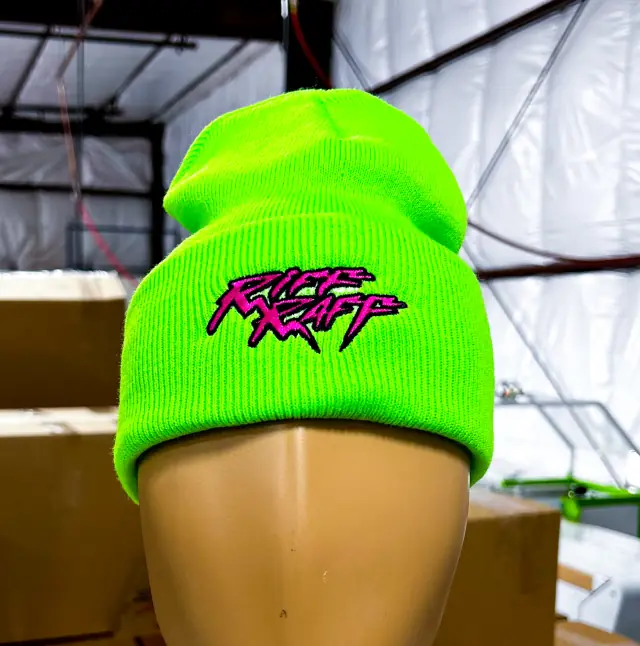
The main beanie shapes
Every beanie is a knitted tube closed at the top. What changes is its length, whether part of it folds back on itself, and what is added to the crown. Those three choices decide how it sits on the head and where a logo can go.
| Style | How it is built | How it sits | Logo space |
|---|---|---|---|
| Cuffed | A long tube folded up into a double-layer band | Over the ears; depth set by how much is folded | The front of the cuff |
| Uncuffed | A shorter, single-layer body | Close to the head, usually over the ears | The body, just above the lower edge |
| Fisherman | A short, shallow body with a narrow cuff | High on the head, at or above the ears | A small area on the short cuff |
| Slouch | Extra length that drapes at the back | Loose, with fabric bunching behind | The cuff or the lower front |
| Pom | A cuffed or uncuffed body with a yarn ball on top | As its base style | As its base style, plus the pom color |
Cuffed
The cuffed beanie is the default custom beanie. Its body is knitted long and folded up, so the wearer can turn it down over the ears in the cold or fold it deeper for a shorter look. Yupoong's 1501KC, for example, measures about 12 inches uncuffed according to its maker, and Richardson lists its 137 as a mid cuffed beanie. The 82-404 and 82-1238 from Otto Cap are 12-inch cuffed styles as well, the second with a rib-knit cuff, and Nissun Cap lists a 12-inch acrylic beanie as its KNIT. The folded band gives two layers of knit where the logo goes, which makes for a firmer embroidery surface and hides the back of the stitches inside the fold.
Uncuffed
An uncuffed beanie, sometimes called a skull cap, is knitted to its finished length with no fold. Yupoong lists its 1500KC at about 8 1/2 inches long, Otto's 82-1173 is a 9 1/2-inch rib knit with no cuff, and Nissun lists an 8-inch acrylic beanie as its BENI. It sits close and looks clean, and it layers well under a hood or a helmet liner. A logo goes on the single layer near the bottom edge, so the back of the embroidery rests against the forehead.
Some uncuffed beanies are lined for warmth. Otto's 82-1317 is a 9-inch acrylic knit with a polyester fleece lining inside, which feels softer against the skin and blocks more wind. A lining also changes decoration, because anything stitched through the knit shows on the fleece inside; beanie decoration covers how to handle it.
Fisherman
The fisherman beanie is short and shallow with a narrow cuff, and it sits on top of the head rather than pulling down over the ears. It is usually rib knit and worn as a style piece in milder cold. "Fisherman" is a description rather than a standard size, so check each maker's uncuffed length and cuff height: two beanies sold under the name can differ noticeably. The short cuff limits the logo to something small, which suits a woven label or a compact stitched mark.
Slouch and pom
A slouch beanie adds length so the crown drapes at the back instead of fitting snug. It reads relaxed and fashion-led, and it fits a wider range of heads loosely. A pom beanie adds a yarn ball to the crown, usually on a cuffed body; Yupoong's 1501P is its cuffed knit beanie with a pom, at the same 12-inch uncuffed length as the 1501KC. Pom color is a design decision in its own right: a contrast pom can echo a logo color.
Knit structure: ribs, gauge and density
A rib knit alternates columns of knit and purl stitches, so the fabric stretches sideways and pulls back in. That elasticity is what lets one beanie fit many heads. Fine ribs look neat and give a smoother surface; wider ribs look chunkier and stretch more.
Gauge is how fine the knitting is. A fine-gauge knit has many small stitches and a smooth face; a chunky knit has fewer, bigger stitches and a lot of texture. Cable, waffle and twist patterns add more texture still. Yupoong lists both a plain and a cuffed waffle-knit beanie, and Richardson's knit range has included chunky cable and twist styles, so textured options are easy to find.
Density matters most for decoration. Yupoong describes its 1500KC and 1501KC as densely knit for easier embroidery, and its 1545K ribbed cuffed beanie as loosely knit. A dense knit holds stitches on top of the surface. A loose knit lets them sink between the ribs, so thin lines and small letters vanish and the fabric can gap around the design. If the logo is detailed, choose a dense, fine knit or plan on a patch; beanie decoration explains the options.
Yarns compared
| Yarn | Warmth | Feel | Care | Embroidery behavior |
|---|---|---|---|---|
| Acrylic | Warm for its weight | Soft; rarely itchy | Easy; many are machine washable | Takes stitches well when densely knit; colors stay bright |
| Wool | The warmest; stays warm when damp | Can feel scratchy on bare skin | Hand wash; can shrink or felt with heat | Good; open wool knits need a topping so stitches sit up |
| Merino wool | Warm, lighter than standard wool | Fine and soft | Gentle wash, low heat | Good on fine knits |
| Cotton | Least warm; breathes | Soft, no itch | Can stretch out and lose shape | Clean and crisp on fine knits |
| Blends | Between their parts | Depends on the mix | Usually easier than pure wool | Follows the dominant fiber and the knit |
Acrylic is the workhorse of stock custom beanies. Every Yupoong knit cap checked for this guide is 100% acrylic, and the maker calls the yarn hypoallergenic; Richardson's 137 is also 100% acrylic and, per its page, machine washable. Otto's 82-1238 and 82-1173 and Nissun's KNIT and BENI are listed as 100% acrylic too. Acrylic holds strong, even color, which helps when a beanie needs to match a brand palette. It can pill with heavy wear.
Wool and merino make sense for outdoor brands, premium retail lines and anyone selling warmth as the feature. They cost more, need gentler washing, and coarser wool can bother sensitive skin. Cotton beanies suit spring, autumn and warm climates, and they feel more like a T-shirt than winter gear. Heathered yarns, which blend fibers of different shades, give a soft, mottled color; see heather for how that look is made.
Sizing and fit
Most stock beanies are sold as one size: Yupoong lists the 1500KC, 1501KC and 1501P as one size fits all, and Richardson lists the 137 as one size fits most. The knit's stretch and, on cuffed styles, the depth of the fold do the fitting. That makes beanies simpler to order than caps or tees, because there is no size run to plan.
To compare styles, lay a sample flat and measure two things: the width across the bottom edge, unstretched, and the length from the crown to the edge with the cuff unfolded. Doubling the flat width gives a rough relaxed circumference, and the knit then stretches beyond that. A longer cuffed beanie fits a wider range of heads than a short uncuffed one because the wearer can trade cuff depth for crown depth.
A few cautions:
- Children. Adult one-size beanies sit loose and deep on small heads; ask for youth versions if many wearers are kids.
- Large heads. Short uncuffed and fisherman styles ride up on bigger heads. A long cuffed style is more forgiving.
- Washing. Acrylic keeps its size well. Wool can shrink or felt if washed warm or tumbled, and cotton can grow with wear.
- Logo placement. On cuffed styles, a design placed for a deep fold sits too high if the wearer folds it shallow, so agree on a standard cuff depth for the mockup.
Matching the style to the wearer
- Staff and company gifts: a classic cuffed acrylic beanie in a neutral color fits nearly everyone and takes a clean embroidered logo. See company merch.
- Outdoor, ski and snow events: a deeper cuffed beanie that covers the ears, in acrylic or a wool blend. See event merch.
- Streetwear and fashion drops: fisherman, slouch or a short uncuffed style with a woven label or a small, precise mark. See clothing brands.
- Surf and skate shops: fisherman and short rib-knit styles in muted colors. See skate and surf shops.
- Family events and youth teams: cuffed styles with youth sizes, or a pom beanie for a playful look.
Whatever the style, check stock early: beanie colors can run short in the cold months, which when to order custom beanies covers in detail.
Sources
- YP Classics 1500KC Knit Beanie (Flexfit), checked 2026-10-04
- YP Classics 1501KC Cuffed Knit Beanie (Flexfit), checked 2026-10-04
- YP Classics 1501P Cuffed Pom Pom Knit Beanie (Flexfit), checked 2026-10-04
- YP Classics 1545K Ribbed Cuffed Knit Beanie (Flexfit), checked 2026-10-04
- YP Classics collection, knit styles (Flexfit), checked 2026-10-04
- Richardson 137 Heathered Beanie with Cuff product page, checked 2026-10-04
- Richardson knits collection, checked 2026-10-04
- Otto Cap 82-404 12" Classic Knit Beanie w/ Cuff, checked 2026-10-04
- Otto Cap 82-1238 12" Classic Knit Beanie w/ Rib Knit Cuff, checked 2026-10-04
- Otto Cap 82-1173 9 1/2" Premium Rib Knit Beanie, checked 2026-10-04
- Otto Cap 82-1317 9" Classic Knit Beanie w/ Inside Fleece Lining, checked 2026-10-04
- Nissun Cap KNIT 12" Beanie, checked 2026-10-04
- Nissun Cap BENI 8" Beanie, checked 2026-10-04
Useful for: clothing brands, companies, skate and surf shops, events.