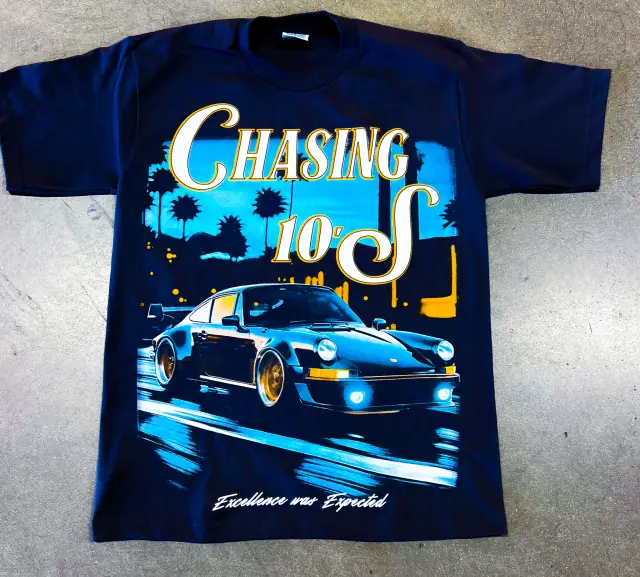
The measurements that define a fit
Fit names are marketing; measurements are facts. Five numbers on a spec chart tell you how a tee will look:
- Body width: measured flat across the chest just below the armholes. Double it for the circumference.
- Body length: from the high point of the shoulder, where the shoulder seam meets the collar, down to the hem.
- Shoulder position: where the shoulder seam lands. On a classic tee it sits near the end of the wearer's shoulder; on a drop-shoulder tee it falls onto the upper arm.
- Sleeve length: from the shoulder seam to the hem, or from center back, which also captures the shoulder width.
- Sleeve opening: how wide the sleeve hem is laid flat. A wide opening is part of the oversized look.
The quickest read of a silhouette is the gap between body length and body width. A long, narrow tee has a big gap; a boxy tee has a small one. Here is the gap at size Medium for three styles, from each maker's own chart:
| Style (Medium) | Body width | Body length | Length minus width | How it reads |
|---|---|---|---|---|
| Gildan 5000 | 20 in | 29 in | 9 in | Classic |
| Comfort Colors 1717 | 20 1/4 in | 28 in | 7 3/4 in | Relaxed |
| WATC Studio Oversized Boxy Tee | 24 in | 27 in | 3 in | Boxy and oversized |
The WATC tee is four inches wider than the Gildan yet two inches shorter, which is the whole boxy look in two numbers. Run the same subtraction on any chart and you can sort a shortlist by boxiness before ordering a single sample.
Classic, relaxed, boxy, oversized and drop-shoulder
| Fit | Body | Length | Shoulder | Sleeve | How it reads |
|---|---|---|---|---|---|
| Classic | Straight, true to size | Standard | Seam at the shoulder point | Mid upper arm | The standard tee |
| Retail or modern | Slimmer through chest and waist | Standard | At the shoulder point | Slightly shorter and narrower | Closer to the body |
| Relaxed | A little roomier | Standard or slightly shorter | At or just past the shoulder | Slightly longer | Easy, lived-in |
| Boxy | Wide and straight, no taper | Short for its width, sometimes cropped | Often slightly dropped | Wide opening | Square and structured |
| Oversized | Bigger everywhere | Longer as well as wider | Clearly dropped | Long, toward the elbow | Deliberately big |
| Drop-shoulder | Any of the above | Any | Seam on the upper arm | Starts lower, so it hangs longer | Slouchy shoulder line |
Drop-shoulder describes where the seam sits rather than the overall size, so a tee can be boxy and drop-shoulder at once. Most streetwear cuts combine a wide body, a shorter length, a dropped shoulder and heavyweight fabric stiff enough to hold the shape; t-shirt weights explained covers the weight side.
How the cut changes print size and placement
A boxy or oversized blank changes the canvas, so the art and its placement should change with it:
- Wider canvas, shorter height. A wide, short body welcomes a wider print but has less vertical room, especially on cropped cuts. A tall print that fits a classic Medium can run into the hem on a boxy Small. Check the art height against the shortest size you will print, or grade the print across the size run. Jumbo prints covers the limits of big art.
- Measure from the collar, not the shoulder seam. On a drop-shoulder tee the shoulder seam sits low, so placing a chest print relative to the seam puts it too low. Printers place front prints a set distance below the collar; tell them if you want the art higher than usual on a short body.
- Sleeve prints move down. A dropped shoulder pushes the top of the sleeve down the arm, so a sleeve print lands lower than on a classic tee. Confirm placement on a mockup built from the actual blank. Sleeve, hood and pocket prints covers fixtures and limits.
- One print size across sizes. Because oversized cuts are already roomy, many labels print one size of art on every shirt in the run. Check how it looks on the smallest and largest sizes before you approve.
- Back prints get more room. The back of a boxy tee is a big, flat area and the natural home for a large graphic. The print placement guide gives typical sizes and distances from the collar.
Sizing advice for your customers
People buy boxy and oversized tees expecting a look, so tell them how to get it:
- Publish garment measurements, not just S to XL. Give body width, length and sleeve in inches and centimeters, and say they are measured flat.
- Say how the shirt is meant to fit. A line such as "boxy cut: wide and slightly short; size down for a closer fit" prevents a lot of exchanges. Makers write these notes too: Shaka Wear says its Max Heavyweight runs slightly oversized in the chest and length and to take your normal size for a regular fit, and Blanks by Thirteen suggests sizing down in one tee for a slightly cropped fit.
- Show it on a person, with their height and the size they are wearing.
- Invite comparison. Ask customers to measure a favorite shirt flat and match it to your chart. How to read a size chart explains the method, and product pages that sell apparel covers where fit notes belong.
- Plan the size run around the fit. If you tell customers to size up in a classic tee for a bigger look, demand shifts toward the larger sizes; a blank that is boxy at true size keeps your usual size curve. See how to plan a size run.
Blank styles with boxy, relaxed and oversized cuts
These examples come from each maker's own description of its fit.
- Boxy and oversized tees. WATC Studio's Oversized Boxy Tee, in organic cotton at 185 or 240 GSM. AS Colour's 8.2 oz Heavy Tee has a boxy relaxed fit with dropped shoulders. Cotton Heritage cuts its 7 oz MC1087 Box Tee as an oversized relaxed fit with a dropped shoulder. Made Blanks describes its 5.5 oz Summer T-Shirt as slightly boxy, slightly cropped and slightly oversized, with shorter sleeves.
- Heavyweight relaxed tees. The Shaka Wear Max Heavyweight is a 7.5 oz classic boxy fit with slightly oversized sleeves, in sizes up to 7XL plus talls. Los Angeles Apparel cuts the 1801GD wider across the shoulder and body, about an inch wider on the flat than a contemporary tee by its own account. Blanks by Thirteen describes several of its tees as a slightly oversized, relaxed drop-shoulder fit.
- Relaxed garment-dyed tees. The Comfort Colors 1717 is a relaxed fit, and the brand also makes a women's boxy heavyweight, the 3023CL.
- Hoodies. The same shapes exist in fleece. Made Blanks' Park Hoodie pairs drop shoulders and baggy sleeves with a boxy chest and a slightly cropped length; how to choose a blank hoodie covers more.
Sizing up is not the same as oversized
Ordering a classic tee one or two sizes up gets you width, but everything else scales too: the body gets longer, the neck opening gets bigger and the sleeves get longer as well as wider. The result often looks like a shirt that is too big rather than one cut to be big. A blank designed boxy or oversized keeps the collar snug and the length controlled while the body and shoulder grow. If no blank gives you the exact proportions you want, cut and sew lets you set every measurement in a tech pack and control how the pattern is graded across sizes.
Sources
- Gildan 5000 product page (sizing), checked 2026-10-04
- Comfort Colors 1717 product page (sizing and companion styles), checked 2026-10-04
- WATC Studio Oversized Boxy Tee (sizing), checked 2026-10-04
- Shaka Wear 7.5 oz Max Heavyweight Short Sleeve (fit guide), checked 2026-10-04
- Los Angeles Apparel 1801GD, checked 2026-10-04
- Los Angeles Apparel 1801GDRIN (fit note), checked 2026-10-04
- AS Colour Heavy Tee 5080, checked 2026-10-04
- Cotton Heritage MC1087 Men's Box Tee, checked 2026-10-04
- Made Blanks Summer T-Shirt, checked 2026-10-04
- Made Blanks Park Hoodie, checked 2026-10-04
- Blanks by Thirteen Mineral Black T-Shirt (fit note), checked 2026-10-04
- Blanks by Thirteen Vintage Olive T-Shirt (fit), checked 2026-10-04
Useful for: clothing brands, creators, skate and surf shops.