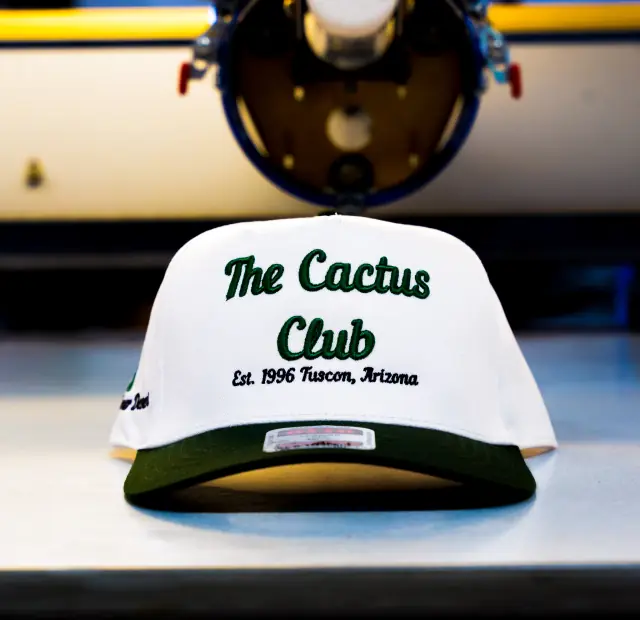
How a foam trucker is built
The front of a foam trucker is a layer of foam with polyester fabric bonded to its face and, on most styles, a thin lining behind it. That sandwich is stiff enough to stand up on its own, so the cap does without buckram, the resin-stiffened cloth that holds up the front of a twill cap. Four mesh panels make up the sides and back, and a plastic snap strap closes the rear opening.
Most foam truckers are five-panel caps. The front is one wide piece with no center seam, set on a high crown that rises nearly straight up from the bill. Richardson's 113 and Otto Cap's 39-165 both follow that pattern according to their makers' pages: five panels, a high crown, a foam front, a mesh back and a snap closure. Otto adds a slim rope across the front above the bill and a terry cloth sweatband; Richardson lists a flat bill on the 113.
Not every foam trucker is equally tall, though. Otto lists the 39-165 and its flat-billed 132-1037 with a 4-inch crown and the 32-467 at 3.4 inches, a lower foam option for people who find the classic shape too big. Nissun Cap sells several poly-foam fronts with a mesh back and plastic snap: the SSC, two-tone SPC and SCC, the flat-billed 5FBC and the 5PMS with a sandwich bill (a thin contrasting stripe along the bill edge). The Otto Cap and Nissun Cap pages cover both makers' ranges.
Because the foam is the structure, the whole front behaves like a soft board. It is light, it springs back from a gentle squeeze, and it gives a decorator a large, smooth face without a ridge down the middle. Those same traits explain both what it does well and where it struggles.
Foam, twill and unstructured truckers compared
"Trucker" only tells you the back panels are mesh. The front can be foam, a structured twill like the cotton-polyester front on the Richardson 112 or the polyester-cotton front on the Yupoong 6006, or a soft cotton front with nothing behind it. Those three fronts behave very differently once a logo goes on.
| Foam front | Structured twill front | Unstructured cotton front | |
|---|---|---|---|
| Front panel | Polyester-faced foam, usually one piece | Twill backed with buckram, one or two panels | Soft twill with no stiffener |
| Usual shape | High crown with a tall, upright face | Low, mid or high | Low and relaxed |
| Strongest decoration | Screen print, heat transfers, sublimation on white fronts | Flat and 3D puff embroidery, patches | Flat embroidery and sewn patches |
| Embroidery | Lighter designs are safest; test dense fills | Takes dense fills and puff | Lighter designs; puff loses its crisp edge |
| Typical look | Retro, loud, souvenir | Classic workwear and streetwear | Washed and casual |
| Shape over time | Holds until the foam is creased | Holds unless crushed | Folds flat by design |
For how crown height and stiffening change the way a cap sits, read cap profiles and fits.
How foam fronts are decorated
The smooth polyester face is the reason foam truckers became a merch staple: ink and heat-applied graphics sit cleanly across the whole front. Embroidery can be done, and both Richardson and Otto list it for their foam styles, but it takes more care than on a twill front.
Screen printing directly on the cap
Caps are printed on a hat platen, a fixture that grips the crown and presents the front as flat as its curve allows. With no center seam, a wordmark can run straight across the middle without the ink skipping over a ridge. Bold spot colors, one to three of them, are the classic foam trucker look. Fine halftones are harder, because the face has a slight texture and the curve stops the screen from meeting every part of the panel evenly.
Neither polyester nor foam tolerates much heat. Printers watch cure temperature and dwell time closely, and on colored polyester they may choose a low-bleed or low-cure plastisol so the fabric dye does not tint a white or pale ink, a problem known as dye migration.
Heat transfers
A transfer is printed first and then pressed onto the cap with a curved heat press. Screen-printed plastisol transfers suit simple art repeated across many caps. DTF transfers carry full color and gradients without a screen per color, which helps short runs of detailed artwork. Heat and pressure have to be set for foam: too much of either can dent the front or leave a shiny press mark around the graphic, so a test press on a spare cap is worth asking for. Otto describes the foam on its 39-165 as formulated for heat transfers as well as embroidery.
Sublimation on white fronts
Sublimation turns dye into a gas that bonds inside polyester fibers, so the result has no feel at all and can carry photographic color. It needs a white or very pale polyester face, which is why white-front foam truckers are sold as sublimation blanks. It cannot put white or light colors onto a dark front, and the mesh will not take it cleanly.
Embroidery
Every needle strike punches a hole through the face and the foam. A light outline or a line of satin lettering survives that easily. A large solid fill is riskier: thousands of holes close together can perforate the foam like the tear line on a sheet of stamps, and on thinner foam the stitched block can sag or pull away from the panel with wear. The stitches can also sink into the soft foam, so the fabric between them bulges and looks quilted. These are risks rather than certainties. Thicker foam sold for embroidery, careful digitizing and the right tension make filled designs workable on many caps, which is why a sew-out matters more here than on almost any other cap.
What helps is lower density, open designs, satin text instead of big fills, a suitable backing behind the front, and a digitizer who has sewn on foam before (see embroidery digitizing). Ask for a test sew-out on the exact style before the run. If the logo needs stitched depth, a structured twill trucker is the better canvas; 3D puff on hats explains why the firm twill front suits raised embroidery.
Patches
A patch carries its detail in its own stitching, weave or molding and only needs a border of stitches, or a heat-activated adhesive, to attach. That makes it the practical way to give a foam front an embroidered look without driving a dense fill into the foam. Custom patches compares the types.
Artwork that suits a foam front
- Design for the face you can reach. The usable area depends on crown height and curve. Ask the decorator for the print template for the exact style rather than scaling art from a product photo.
- Keep it bold. Thick letters and solid shapes read from across a bar or a festival field, which is the whole point of a foam trucker. Hairlines and small type disappear into the textured face.
- Clear the rope and the bill seam. On roped styles, leave space above the rope so it does not crowd the bottom of the design.
- Plan colors against the front and the mesh together. Two-tone caps with a white front and colored mesh let the print pick up the mesh color for a matched set.
- Send vector art. Screens and transfers both need clean edges; preparing artwork for screen printing covers the file side.
- Approve a mockup on the real colorway. A generic cap outline hides how the art sits against the crown height and rope.
Durability, care and shipping
In normal wear the foam front keeps its shape well, but a hard crease from sitting on the cap or cramming it into a bag can leave a permanent dent, and a print that crosses the dent may crack. Long sun exposure can fade the polyester face, and old foam can yellow or turn brittle.
Spot cleaning is the safe routine: a damp cloth, mild soap, cool water and air drying on a rounded form. Machine washing and tumble drying are hard on the foam, the bill and the print.
Shipping matters more than people expect. Caps travel best nested front-into-front in a stack inside a box sized to stop them shifting. A foam cap crushed flat in a soft mailer can arrive creased. Packaging for apparel orders covers boxes, mailers and how to protect decorated goods.
Sizing and fit
Nearly all foam truckers close with an adjustable snap strap and are sold in one adult size. Richardson lists its 113 as one size fits most, and Otto lists its foam caps for hat sizes 6 1/2 to 7 5/8. The high crown sits tall and deep, which suits larger heads and the deliberately oversized retro look, but it can swamp smaller heads and kids.
Smaller sizes do exist. Otto offers the 39-165 in a young adult size for hat sizes 6 to 7 1/8, with a 3.5-inch crown instead of 4 inches, and Nissun lists youth versions of its SSC, SPC and NSC foam caps. If your crowd includes plenty of smaller heads, look at those, or at a mid crown foam cap such as the 32-467, and order a sample of each. Popular trucker hat styles lays the makers' published crown heights side by side.
Who orders foam truckers, and when another cap fits better
Foam truckers suit merch that should be loud, readable and a little nostalgic. A band can print the tour name big enough to read from the back of a venue (band merch). A brewery or bar can turn a label design into a cap people wear to the next release (brewery merch). Surf and skate shops use them for the retro beach look (skate and surf shops), and festivals and one-day events like them because a printed front turns around artwork quickly and carries dates and lineups (event merch).
Pick a different cap when the brand wants a stitched, premium feel, when the cap is meant for daily wear over several years, or when most wearers have smaller heads. A structured twill trucker with flat or 3D puff embroidery gives depth and lasts longer under hard use, and hat decoration options compares every method side by side.
Questions to ask before you order
- Which foam styles can you source, and what crown height, bill shape and closure does each one have?
- Will the front be screen printed, transferred, sublimated or embroidered, and why that method for this artwork?
- What is the printable or stitchable area on this exact style?
- Can I see a test print or sew-out on the actual cap and colorway?
- How are cure temperature and press pressure set so the foam does not dent or scorch?
- How will the finished caps be packed so the fronts arrive without creases?
Sources
- Richardson 113 Foamie Trucker product page, checked 2026-10-04
- Otto Cap 39-165 5 Panel High Crown Mesh Back Trucker Hat product page, checked 2026-10-04
- Otto Cap: foam front trucker hats, checked 2026-10-04
- Otto Cap 32-467 5 Panel Mid Profile Mesh Back Trucker Hat, checked 2026-10-04
- Otto Cap 132-1037 OTTO SNAP 5 Panel High Crown Mesh Back Trucker Snapback Hat, checked 2026-10-04
- Nissun Cap SSC Summer Mesh Cap, checked 2026-10-04
- Nissun Cap SPC Summer Mesh Cap, two-tone, checked 2026-10-04
- Nissun Cap SCC Summer Mesh Cap, two-tone, checked 2026-10-04
- Nissun Cap 5FBC Flat Bill Summer Mesh Cap, checked 2026-10-04
- Nissun Cap 5PMS 5 Panel Mesh with Sandwich Bill Cap, checked 2026-10-04
- Nissun Cap youth caps category (SSCY, SPCY, NSCY), checked 2026-10-04
Useful for: bands, breweries, skate and surf shops, events.